
B12, Folate and Ferritin in Pregnancy: What New Research Means for You
This article is written by our clinical team for the women and families we meet every day. It is meant to inform you, not to replace a consultation, and every recommendation here is one we would give you in the room.
Two recent updates - one on birth defects, one on iron testing - and the questions worth asking at your next antenatal visit.
You took your folic acid every day. Your haemoglobin report said “normal”. So why are doctors suddenly talking about vitamin B12 and ferritin?
Because two pieces of new research, both from 2026, are changing how we think about nutrition and screening around pregnancy. Here is what they say, in plain language, and what they do not.
This article is for general educational purposes only and does not replace personalised medical advice, diagnosis, or treatment. Talk to your provider about your specific symptoms and test results.
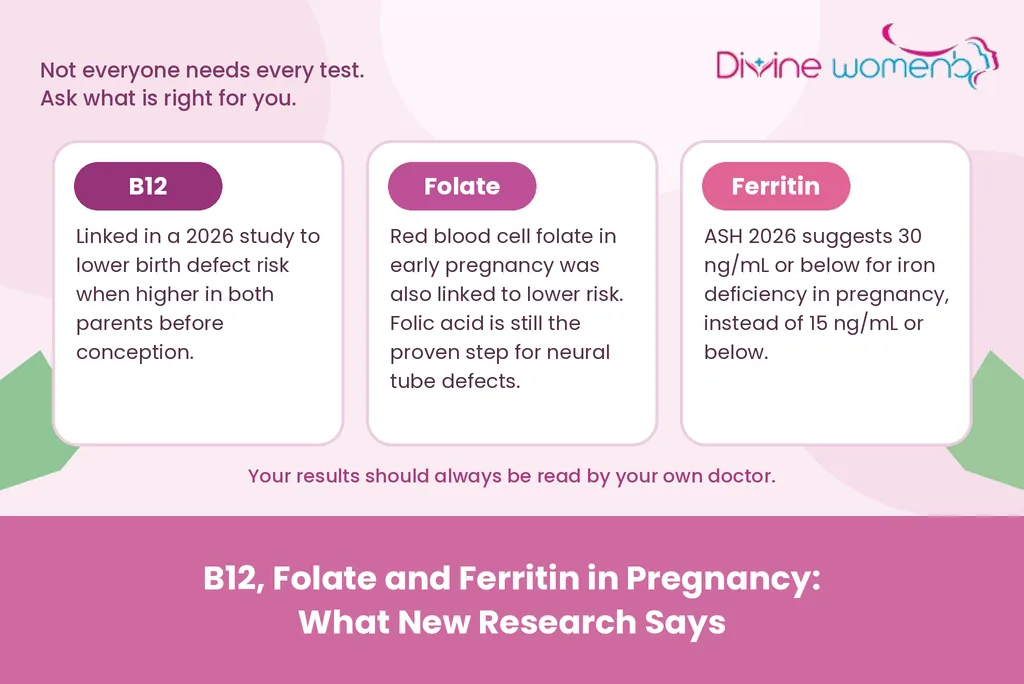
In short: a 2026 study found that higher B12 in both parents before conception, and adequate folate in the mother early in pregnancy, were linked to fewer birth defects - an association, not proof. Separately, the American Society of Hematology raised the ferritin cut-off for diagnosing iron deficiency in pregnancy to 30 ng/mL or below, so a woman whose haemoglobin reads normal may still have low iron stores. Neither finding is a reason to self-treat; both are reasons to ask for the right test.
What did the new B12 and folate research find?
A large study published in September 2026 in the Annals of Internal Medicine followed couples in China and measured folate and vitamin B12 in the blood cells of both parents around the time of conception.
Higher B12 in both mothers and fathers before conception was linked to fewer birth defects. Adequate folate in the mother during early pregnancy was also linked to a lower risk.
The study looked mostly at defects other than neural tube defects, including heart defects. Folic acid is already well known to help prevent neural tube defects. This research suggests B12 may matter for other kinds of birth defects too.
Folic acid is still essential, but it may not be the only nutrient that matters around conception.
Does this mean fathers need to think about B12 too?
It is an interesting finding, and it is the first thing most people ask about. In this study, a father’s B12 level before conception was associated with the baby’s risk, too.
That does not mean a father’s diet causes birth defects. It means the picture is bigger than just the mother, and that both partners’ nutrition may be worth a look when planning a pregnancy.
What should we be careful about with this research?
This was an observational study. It shows an association, not proof that taking more B12 prevents birth defects. It was also done in one country, so the results may not be the same for every population.
So please do not rush to buy high-dose supplements. More is not automatically better, and a blood test tells you far more than guessing does.
Who is more likely to be low in B12 or folate?
B12 comes mainly from animal foods such as milk, eggs, fish and meat. So people who eat little or no animal food can run low, and so can those with certain stomach or gut conditions, or who take some long-term medicines.
Folate comes from green leafy vegetables, pulses and fortified foods. A diet low in these, or a pregnancy that was not planned, can leave levels short in the crucial early weeks.
A 2026 review in Frontiers in Nutrition also looks at how B12 deficiency in pregnancy affects antenatal care across South Asia, which is a good reminder that it is an issue worth taking seriously here.
What are the updated ferritin cut-offs, and why do they matter?
Ferritin is a blood test that shows how much iron your body has stored. Haemoglobin only drops once those stores are running low, so ferritin can spot a problem earlier.
For years, many laboratories used a cut-off of around 15 ng/mL to say iron was low. In 2026, the American Society of Hematology published new guidelines. They suggest a higher threshold of 30 ng/mL or below for diagnosing iron deficiency in pregnancy, at any stage. They also say a threshold up to 50 ng/mL may apply if someone is already anaemic. And they strongly advise against using 15 ng/mL or below in pregnancy.
ACOG, the American College of Obstetricians and Gynecologists, already uses a figure of below 30 ng/mL for diagnosing iron deficiency in pregnancy. But it does not currently recommend routine screening for everyone.
Can you have low iron even if your haemoglobin is normal?
Yes, and this is the biggest myth to clear up.
Myth: “My haemoglobin is fine, so my iron must be fine.” Fact: you can have low iron stores before your haemoglobin falls. The ASH panel specifically notes that haemoglobin and red blood cell size are unreliable stand-ins for iron stores.
A higher cut-off catches more women earlier, so iron can be replaced before it turns into anaemia. That is the whole point.
One caution: infection and inflammation can push ferritin up, which can hide low iron. This is why your doctor reads the result alongside your symptoms and other tests, not on its own.
Researchers are still debating thresholds. Another 2026 study suggested even higher limits in the first trimester, so expect this area to keep evolving.
What can you do before and during pregnancy?
You do not need to panic, and you do not need to self-treat. Here is a calm plan:
- Planning a pregnancy? Ask about a preconception check, including B12, folate and iron status for you, and your partner’s B12 if that is recommended.
- Already pregnant? Ask whether a ferritin test makes sense alongside your haemoglobin, especially if you are tired, pale, short of breath, or have had heavy periods or previous anaemia.
- Take folic acid as your doctor advises, ideally starting before conception.
- Do not start high-dose iron or B12 on your own. Too much iron causes side effects too, and the right dose depends on your results.
- Eat well: leafy greens, pulses, dairy or eggs if you eat them, and iron-rich foods with a source of vitamin C.
If you already have a pregnancy that needs closer monitoring, high-risk pregnancy care means one team looks at your history, your tests and your scans together.
The bottom line
Two things are worth remembering. First, B12 and folate in both parents around conception may matter for more kinds of birth defects than we thought. Second, the ferritin level used to diagnose iron deficiency in pregnancy is moving higher, so more women who are “normal on paper” may actually be low.
Neither finding means you should treat yourself. They mean it is worth asking the right questions and getting the right tests.
If you are planning a pregnancy, or want to talk through your antenatal tests, read about prenatal and postnatal care and fetal medicine at Divine Women’s Hospital, a NABH-certified women’s hospital in Gota, Ahmedabad.
What to expect at Divine Women's Hospital
Choosing where to be cared for is a personal decision, and it usually comes down to one question: will someone actually listen to me? At Divine Women's Hospital, that is where every consultation begins. Our senior consultants stay with you from the first visit through recovery, so you never have to repeat your story to a new face.
One consultant, start to finish
The doctor who examines you is the doctor who plans your treatment and performs your procedure. Continuity is not a luxury here, it is the baseline.
Explained in plain language
Reports are walked through line by line, in Gujarati, Hindi or English, until the plan makes sense to you and the family member sitting beside you.
Modern theatre and imaging under one roof
Laparoscopy suites, fetal-medicine grade ultrasound, NICU support and 24x7 emergency cover mean fewer referrals and less waiting between steps.
Honest, itemised costs
You receive a written estimate before admission. If the plan changes, we tell you why before anything is done.
Related Reads
17 October 2026
Genetic Screening & Pre-Pregnancy Tests: What to Know
Carrier screening tells you something prenatal testing can't: your risk of passing on an inherited condition while every reproductive option is still open. What the panels check, how the guidelines differ, and why timing it before conception changes what you can do with the result.
Read more
17 October 2026
Managing Pre-Existing Conditions (Diabetes, Thyroid, BP) Before Pregnancy
Diabetes, thyroid disease and chronic hypertension all need specific targets hit before conception, not after a positive test. The glucose, TSH and blood pressure numbers to aim for, plus which medications have to be switched or washed out first.
Read more
29 September 2026
Gestational Diabetes: Causes, Risks & Management During Pregnancy
Gestational diabetes now affects roughly 1 in 7 pregnancies worldwide - but a GDM diagnosis is highly manageable, not a foregone complication. Diagnostic criteria, glucose targets, medication options and postpartum follow-up explained.
Read moreWe are here for you
Book a consultation with our women's health team in Ahmedabad
Obstetricians, gynecologists, fertility specialists and a neonatologist, with hospital staff available 24×7 for you and your baby.