
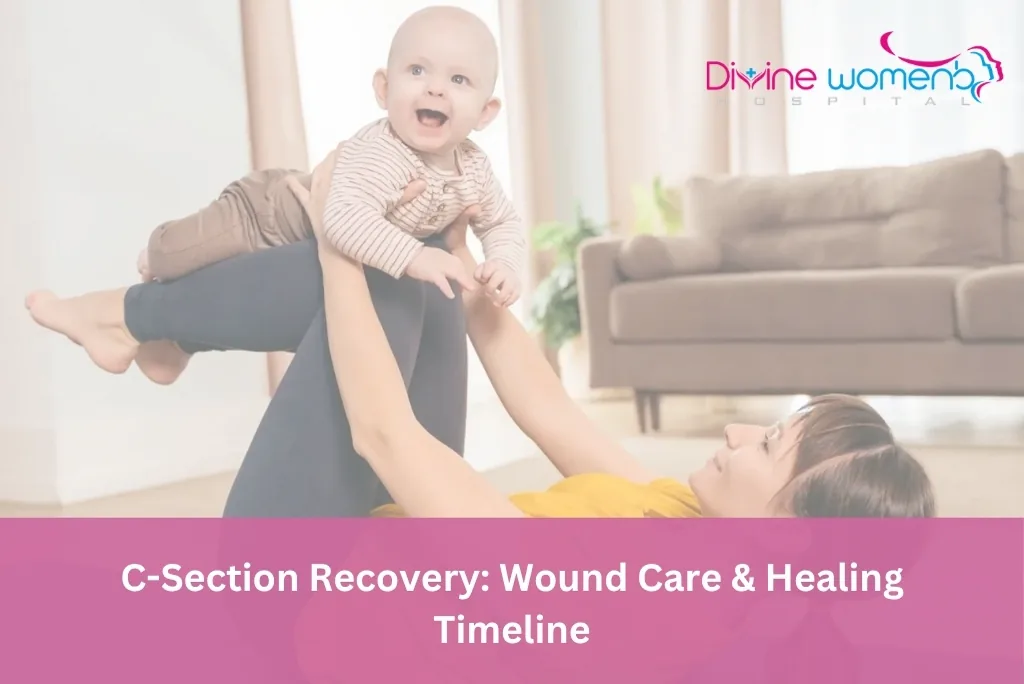
C-Section Recovery: Wound Care & Healing Timeline
This article is written by our clinical team for the women and families we meet every day. It is meant to inform you, not to replace a consultation, and every recommendation here is one we would give you in the room.
A cesarean is major abdominal surgery, and recovery involves healing through several tissue layers - not just the visible skin incision - on a notably longer timeline than vaginal birth recovery. This guide walks through the evidence-based wound care timeline, when scar massage is actually safe to start, how abdominal binders help, and what diastasis recti recovery really looks like month by month.
This article is for general educational purposes only and does not replace personalised medical advice. Scar massage, binder use and exercise progression should be cleared by your provider, especially before your six-week postpartum check.
In short: C-section recovery moves through four phases - acute care (days 0-14) focused on infection prevention and pain control, subacute healing (weeks 2-6) as the incision closes, early maturation (weeks 6-12) when scar massage and core rehab begin, and functional remodelling (months 3-18) for deeper tissue and full activity return. Watch for spreading redness, fever over 38.0 C (100.4 F), or wound drainage as infection warning signs.
Key Takeaways
- Cesarean delivery carries up to 20 times the infection risk of vaginal birth, which is why perioperative antibiotic timing matters so much.
- Early dressing removal, at or before 24 hours, is now preferred over the older 48-hour standard - it doesn't increase complications and improves comfort.
- Direct scar massage should wait until the incision is fully closed with no scabs or drainage, typically around 2-4 weeks for indirect work and 6-8 weeks for direct massage.
- Up to 60% of postpartum women have diastasis recti at 6 weeks, and about 32% still have it at 12 months without targeted rehab.
- Uterine scar thickness measured by ultrasound at 3.5 mm or more predicts a strong chance of a successful VBAC in a future pregnancy.
Why C-Sections Carry Higher Infection Risk
Cesarean wound healing refers to the layered recovery of tissue disrupted during a C-section - skin, subcutaneous fat, abdominal fascia and the uterine hysterotomy incision - each healing on its own timeline, from the visible scar closing within weeks to deep tissue remodelling continuing for up to 18 months.
A cesarean is classified as a "clean-contaminated" surgery because the incision passes near the cervix and upper vagina. Surgical site infections occur in roughly 3-15% of cesarean deliveries, and the overall infection risk after a C-section can run up to 20 times higher than after a vaginal birth. This is why perioperative protocols matter so much: a single IV dose of cefazolin given before the skin incision, not after cord clamping, reduces surgical site infection risk by 60-70%. Weight-based dosing applies - 1 g under 80 kg, 2 g for 80-119 kg, 3 g at 120 kg or more - with clindamycin plus an aminoglycoside used instead for penicillin-allergic patients. If labour or ruptured membranes preceded the surgery, adding IV azithromycin further covers bacteria from the vaginal tract that raise infection risk.
Surgical technique also affects healing. Chlorhexidine-alcohol skin prep outperforms povidone-iodine, at a 4.0% versus 7.3% infection rate, and stitching closed the fat layer when it is thicker than 2 cm meaningfully lowers wound complications and fluid collection, or seromas, underneath the skin.
The Four-Phase Recovery Timeline
| Phase | Timing | Primary goals | Key milestone |
|---|---|---|---|
| I: Acute care | Days 0-14 | Prevent infection, manage pain, encourage early walking | No fever, spreading redness or drainage |
| II: Subacute healing | Weeks 2-6 | Complete skin closure, reduce swelling, restore pelvic floor alignment | Skin adhesives fully shed, no active drainage |
| III: Early maturation | Weeks 6-12 | Mobilise scar tissue, restore sensation, build core endurance | Cleared at the six-week visit for progressive exercise |
| IV: Functional remodelling | Months 3-18 | Release deep fascial restrictions, rebuild full core strength | Normalised inter-recti distance, ultrasound scar check if planning a future pregnancy |
Modern Enhanced Recovery After Cesarean (ERAC) protocols have replaced prolonged bed rest with active, early rehabilitation. Early dressing removal, multimodal pain control and early walking are now standard rather than exceptions.
Pain Management After Surgery
Current protocols move away from heavy opioid use.
- Before surgery: oral gabapentin plus neuraxial (spinal) morphine reduces how much opioid medication is needed afterwards.
- First 24-48 hours: IV ketorolac, an NSAID, addresses both uterine cramping and incision pain.
- After discharge: scheduled oral acetaminophen plus ibuprofen provides solid coverage without the sedation or digestive side effects of opioids, supporting earlier and easier movement.
On dressing removal. The older standard kept dressings on for 48 hours or more. Trial data now shows removing them at or before 24 hours is just as safe - a 17.9% versus 19.4% complication rate, which is not a meaningful difference - and improves comfort, since early air exposure supports healing better than a moist, covered environment once the wound is dry and well closed.
Scar Massage: When and How
Tissue healing happens in three overlapping stages: inflammation (days 1-6), proliferation (days 4-21) and remodelling (week 3 up to 18 months), during which disorganised collagen gets replaced by properly aligned fibres. Without any mechanical input, this can form restrictive adhesions - the "C-section shelf" some people notice - along with localised pain or reduced trunk mobility.
| Timing | Technique | What it does |
|---|---|---|
| Before full closure | None - contraindicated | Direct work risks infection and reopening |
| Weeks 2-4 | Indirect massage, 2-3 inches from the scar | Reduces swelling, improves lymphatic drainage |
| Weeks 6-8, after full closure is confirmed | Direct linear or circular massage on the scar | Breaks up collagen cross-links |
| Weeks 8-12 and beyond | Skin rolling, myofascial release, silicone cupping | Releases deeper fascial restrictions |
For numbness or oversensitivity around the scar, which is common after nerve disruption, gradually introducing rougher textures - silk, then cotton, then terrycloth - or alternating warm and cool compresses helps retrain sensory nerves.
What the Evidence Shows
Early dressing removal trials found complication rates of 17.9% with early removal versus 19.4% with delayed removal - a difference so small it isn't clinically meaningful - while satisfaction scores were notably higher with earlier removal.
On future pregnancy planning, ultrasound-measured lower uterine segment thickness of 3.5 mm or more predicts VBAC success with 78.8% sensitivity. Thickness between 2.5 and 3.4 mm calls for closer intrapartum monitoring, while under 2.5 mm signals significant thinning that often favours a planned repeat cesarean over a labour trial.
Abdominal Binders: What They Actually Do
Support binders provide real, evidence-backed benefit in early recovery. Uniform compression reduces shear forces on the healing incision, lowers pain scores and reduces the need for breakthrough opioid medication in the first 7-14 days, while also splinting the abdomen against sudden pressure spikes from coughing, sneezing or laughing, and lowering the risk of early hernia.
That said, binders are meant to be a temporary aid. Relying on one long-term without actively engaging your deep core muscles can actually delay full core strength recovery, so gradual weaning as your own muscle control returns is the standard recommendation.
Diastasis Recti Recovery, Phase by Phase
Diastasis recti, the separation of the abdominal muscles along the midline, affects the large majority of postpartum women at six weeks, with about a third still showing separation a year later. A C-section adds to this, since the surgery itself cuts through the deep abdominal fascia.
| Phase | Timeline | Focus | Avoid |
|---|---|---|---|
| I: Deep core foundation | Weeks 0-6 | Diaphragmatic breathing, gentle core activation | Crunches, sit-ups, planks, lifting beyond the baby's weight |
| II: Dynamic re-connection | Weeks 6-12 | Heel slides, modified dead bugs, standing marches | High-impact running, plyometrics |
| III: Progressive loading | Months 3-6 | Bird-dogs, incline planks, resistance band work | Uncontrolled high-velocity trunk rotation, heavy powerlifting without clearance |
| IV: Advanced integration | Months 6-12 and beyond | Full planks, multi-planar resistance training, return to sport | Exercising through pain, visible doming, or leakage |
Watch for "doming" or "coning" - a ridge appearing down your midline during a movement. It signals your core isn't yet managing pressure well enough for that exercise, and it's a cue to scale back to the current phase's work rather than push forward. If you're already thinking ahead to a future vaginal birth after this cesarean, scar strength and healing directly factor into whether that's a safe option next time.
Warning Signs to Watch For
Redness spreading more than 1 cm beyond the incision, pus or foul-smelling drainage, wound edges separating, a fever above 38.0 C (100.4 F), or calf swelling and pain that could indicate a blood clot all need prompt evaluation rather than home monitoring.
Frequently Asked Questions
Removing the dressing at or before 24 hours is just as safe as the older 48-hour standard, with no meaningful increase in infection, dehiscence or seroma, and higher patient comfort scores.
Conclusion
C-section recovery is really several parallel healing processes - skin, fascia, deep core muscle and the uterine scar itself - each on its own timeline. Following evidence-based steps, including early but gentle mobilisation, properly timed scar massage, smart binder use and a phased return to core exercise, supports all of them at once. Knowing the specific infection warning signs means you can act quickly if something falls outside the expected pattern. Ask your provider to walk through your specific incision closure method and healing timeline at your first postpartum check, and get explicit clearance before starting direct scar massage or progressing your core exercise phase.
Emergency Notice
Seek prompt medical care for a fever above 38.0 C (100.4 F), spreading wound redness, pus or foul-smelling drainage, visible wound separation, sudden shortness of breath or chest pain, or calf swelling and pain. These can signal infection or a blood clot that need urgent treatment.
References
- Cleveland Clinic - C-Section: Procedure, Risks and Recovery.
- StatPearls and NCBI - Cesarean Delivery.
- PMC - Postcesarean Wound Infection: Prevalence, Impact, Prevention.
- PubMed - Guidelines for Postoperative Care in Cesarean Delivery (ERAC).
- Cleveland Clinic - Diastasis Recti (Abdominal Separation).
- Healthline - Abdominal Binder: Safety, Uses and More.
Postnatal checks at Divine Women's Hospital, Ahmedabad cover incision healing, scar massage clearance and a phased return to core exercise - and you don't have to wait for the six-week visit if the wound looks wrong. Our maternity team is available for postpartum concerns around the clock.
Why families across Gujarat trust Divine Women's Hospital
Choosing where to be cared for is a personal decision, and it usually comes down to one question: will someone actually listen to me? At Divine Women's Hospital, that is where every consultation begins. Our senior consultants stay with you from the first visit through recovery, so you never have to repeat your story to a new face.
One consultant, start to finish
The doctor who examines you is the doctor who plans your treatment and performs your procedure. Continuity is not a luxury here, it is the baseline.
Explained in plain language
Reports are walked through line by line, in Gujarati, Hindi or English, until the plan makes sense to you and the family member sitting beside you.
Modern theatre and imaging under one roof
Laparoscopy suites, fetal-medicine grade ultrasound, NICU support and 24x7 emergency cover mean fewer referrals and less waiting between steps.
Honest, itemised costs
You receive a written estimate before admission. If the plan changes, we tell you why before anything is done.
Related Reads
7 September 2026
Endometriosis Surgery Recovery: A Week-by-Week Timeline and Care Guide
What to expect in the days, weeks, and months after excision or laparoscopic surgery - and how to heal well. Recovering from endometriosis surgery isn't a single event; it's a gradual process that unfolds over weeks to months.
Read more
17 October 2026
Vaginal Birth Recovery: Soreness, Discharge & Afterpains Explained
Uterine afterpains, lochia stages and perineal healing all follow a predictable timeline after a vaginal birth. What is normal week by week, and the handful of warning signs that mean you should call your provider rather than wait.
Read more
29 September 2026
C-Section vs Normal Delivery: What to Expect
Knowing what actually differs between the two - physically, medically, and in recovery - helps you ask better questions at your prenatal visits. Risks, recovery times, when a caesarean is necessary, and VBAC success rates.
Read moreWe are here for you
Book a consultation with Ahmedabad's trusted women's health team
Internationally certified obstetricians, gynecologists and fertility specialists, available 24×7 for you and your baby.