
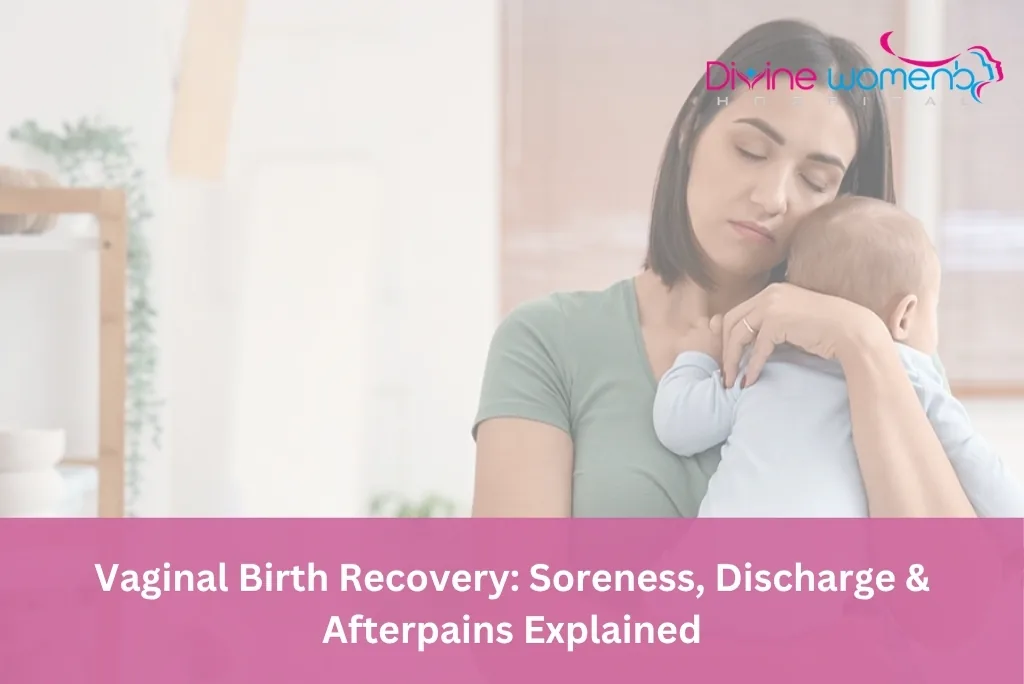
Vaginal Birth Recovery: Soreness, Discharge & Afterpains Explained
This article is written by our clinical team for the women and families we meet every day. It is meant to inform you, not to replace a consultation, and every recommendation here is one we would give you in the room.
The weeks after a vaginal birth bring a specific, predictable set of physical changes - uterine cramping, changing discharge and perineal soreness - quite different from recovery after a cesarean. This guide walks through what is actually happening in your body during each stage of recovery, what is normal, and which warning signs mean it's time to call your provider.
This article is for general educational purposes only and does not replace personalised medical advice. If you're experiencing any of the warning signs described below, contact your provider or seek care promptly rather than waiting.
In short: postpartum recovery runs along three tracked processes. Uterine involution, with its afterpains, shrinks your uterus from about 1,000 g to 50-100 g over six weeks. Lochia progresses from heavy red to pink-brown to light yellow-white over roughly 4 to 6 weeks. Perineal healing takes 1 to 6 weeks depending on tear severity. Heavy bleeding, large clots, fever or worsening pain are signs to call your provider.
Key Takeaways
- Afterpains are typically milder in first-time mothers and more intense in subsequent births - a real physiological difference, not just perception.
- Lochia moves through three colour-coded stages (rubra, serosa, alba), with a median total duration of 27 to 36 days.
- Soaking a pad in under an hour, or passing a clot bigger than a golf ball (about 2.5 cm), both warrant prompt medical attention.
- Ibuprofen is the first-line afterpain treatment and is safe even for patients recovering from preeclampsia.
- Secondary postpartum hemorrhage - heavy bleeding between 24 hours and 6 to 12 weeks postpartum - affects up to 2% of patients and needs prompt evaluation.
Uterine Involution and Afterpains
Uterine involution is the process by which the uterus contracts and shrinks back toward its pre-pregnancy size after birth. Lochia is the postpartum vaginal discharge - a mix of blood, tissue and mucus - that reflects the healing of the uterine lining as it happens.
Right after birth, your uterus weighs about 1,000 g (roughly 2.5 lb), with the fundus palpable at or just below your belly button. Over the next six weeks it shrinks dramatically: to about 500 g by the end of week one, and down to its final non-pregnant weight of 50-100 g by week six. This happens through myometrial contraction and cellular breakdown, and the contractions serve a second purpose beyond shrinking the uterus - they compress the blood vessels left open at the placental site, which is what controls bleeding.
Those same contractions are what cause afterpains. Breastfeeding intensifies them directly: infant suckling triggers oxytocin release from the brain, and oxytocin is exactly what drives myometrial contraction. That's why cramping so often spikes during a feeding session in the early days.
Why Afterpains Differ by Parity
| First-time mothers | Subsequent births | |
|---|---|---|
| Uterine muscle tone | Stays firm, with continuous tonic contraction | Reduced tone from prior stretching |
| Contraction pattern | Steady, sustained contraction | Forceful, intermittent contractions |
| Pain intensity | Typically mild to minimal | Often noticeably more intense |
| Why | Continuous contraction maintains blood vessel compression without repeatedly relaxing and re-contracting | Repeated relax-and-clamp cycles cause brief tissue ischemia, which registers as more pain |
Afterpains typically peak on day 2 to 3 after delivery and fade over 7 to 10 days.
Managing Afterpains
First-line medication. Ibuprofen is the standard first choice - it blocks the prostaglandins that sensitise pain receptors and trigger uterine spasms. Trial data confirms it doesn't raise blood pressure any more than acetaminophen does, making it safe even if you're recovering from preeclampsia or another hypertensive condition.
Non-drug measures.
- A warm compress or heating pad on the lower abdomen eases muscle ischemia.
- Emptying your bladder frequently prevents a full bladder from displacing the uterus and interfering with contraction.
- Lying on your side can reduce discomfort compared with lying flat.
Lochia: The Three Stages of Discharge
| Stage | Typical timing | Appearance | What's happening |
|---|---|---|---|
| Lochia rubra | Days 1-4 | Dark or bright red, heavy flow, small soft clots | Blood, decidual tissue and membrane fragments shedding |
| Lochia serosa | Days 4-12 | Pink-brown, thin and watery, stale or metallic smell | Lighter flow, with rising white blood cell content as the site heals |
| Lochia alba | Day 10-14 up to 4-6 weeks or more | Creamy yellow-white, minimal flow or light spotting | Active tissue regeneration at the healing placental site |
Two things commonly cause a sudden, harmless-looking surge in flow: standing up after lying down for a while, when pooled blood releases all at once, and breastfeeding or physical activity, where oxytocin-driven contractions push out pooled fluid. Neither is cause for alarm on its own.
Perineal Healing by Tear Degree
| Degree | What's involved | Typical healing time | Care notes |
|---|---|---|---|
| First degree | Skin and vaginal lining only | 1-2 weeks | May not need stitches, minimal pain |
| Second degree | Skin, mucous membrane and underlying muscle | 3-4 weeks | Repaired with dissolvable stitches, localised soreness and swelling |
| Third degree | Extends into the anal sphincter muscle | 4-6 weeks | Repaired in theatre, antibiotics and stool softeners needed |
| Fourth degree | Extends through the sphincter into the rectal lining | 6 weeks or more | Higher risk of pelvic floor issues, strict bowel management |
Perineal pain typically peaks in the first week, driven by tissue stretching, swelling and sometimes thrombosed hemorrhoids from pushing, which can cause their own intense and separate discomfort during bowel movements.
Evidence-Based Perineal Care
| Intervention | Timing | Why it helps |
|---|---|---|
| Ice packs or cold gel pads | 10-20 minutes at a time, first 24-72 hours | Reduces swelling and numbs the area |
| Peri bottle (warm water rinse) | Every bathroom trip | Dilutes urine to prevent stinging on healing tissue |
| Warm sitz baths | 15-20 minutes, 2-3 times daily, starting 12-24 hours after birth | Boosts blood flow to speed healing |
| Witch hazel pads or topical anesthetic sprays | As needed | Reduces local inflammation and irritation |
| Stool softener, fibre (25-30 g/day) and fluids (8-12 cups/day) | Daily | Prevents straining on healing tissue |
| Sitting position | Use flat cushions or side-lying, avoid unpadded donut pillows | Donut pillows can actually increase tension on the wound edges |
What the Evidence Shows
Comparative trial data shows postpartum ibuprofen use doesn't elevate mean arterial pressure or increase severe hypertension risk relative to acetaminophen - reassuring safety data even for patients with a hypertensive pregnancy history.
Cohort studies using survival analysis put the median total duration of lochia at 27 to 36 days, though light spotting persists up to 60 days in as many as 13% of otherwise healthy postpartum patients. That is a wide but still normal range, worth knowing before you assume something is wrong.
Warning Signs to Call Your Provider
| Symptom | Possible cause | Threshold |
|---|---|---|
| Heavy bleeding | Postpartum hemorrhage, uterine atony, retained tissue | Soaking one thick pad per hour for 2 hours or more in a row |
| Large blood clots | Subinvolution, retained tissue | Clots larger than a golf ball, about 2.5 cm |
| Lochia reversing course | Subinvolution of the placental site | Bright red bleeding returning after it had lightened, or persisting past day 7-10 |
| Fever or foul odour | Endometritis, wound infection | Temperature above 38 C (100.4 F), or putrid-smelling discharge |
| Worsening perineal pain | Hematoma, wound infection or separation | Escalating pain, expanding swelling, or visible wound separation |
Secondary postpartum hemorrhage - heavy bleeding any time between 24 hours and 6 to 12 weeks after delivery - affects up to about 2% of postpartum patients. It is most often caused by subinvolution, retained tissue or infection, all of which need prompt medical evaluation rather than home monitoring.
Frequently Asked Questions
Cohort data puts the median total duration at 27 to 36 days, but light spotting for up to 60 days occurs in roughly 13% of healthy postpartum patients - a wider normal range than many people expect.
Conclusion
Vaginal birth recovery follows a predictable biological script - uterine involution, lochia progressing through three colour-coded stages, and perineal healing on a timeline set by tear severity. Knowing what is expected at each stage makes it much easier to spot the handful of warning signs that mean it's time to call your provider instead of waiting it out. Tracking your bleeding, pain level and any fever day by day during the first two weeks gives your provider the specifics they need to answer quickly. If you're still finalising your preferences before delivery, this pairs naturally with your birth plan's postpartum section, and with our guide to normal delivery aftercare.
Emergency Notice
Seek immediate care for soaking through a pad in under an hour, passing large clots, a fever above 38 C (100.4 F), foul-smelling discharge, or severe or rapidly worsening perineal pain. These can signal hemorrhage or infection that need prompt treatment.
References
- StatPearls and NCBI - Physiology, Postpartum Changes.
- Cleveland Clinic - Lochia (Postpartum Bleeding).
- Mayo Clinic - Postpartum Care: What to Expect After a Vaginal Birth.
- MDPI - Ibuprofen versus Acetaminophen After Delivery in Hypertensive Patients.
- NP Women's Healthcare - Recognition and Management of Secondary Postpartum Hemorrhage.
Postnatal checks at Divine Women's Hospital, Ahmedabad cover perineal healing, bleeding patterns and pain management, and you don't have to wait for the six-week visit if something feels wrong. Our maternity team is available for postpartum concerns around the clock.
Why families across Gujarat trust Divine Women's Hospital
Choosing where to be cared for is a personal decision, and it usually comes down to one question: will someone actually listen to me? At Divine Women's Hospital, that is where every consultation begins. Our senior consultants stay with you from the first visit through recovery, so you never have to repeat your story to a new face.
One consultant, start to finish
The doctor who examines you is the doctor who plans your treatment and performs your procedure. Continuity is not a luxury here, it is the baseline.
Explained in plain language
Reports are walked through line by line, in Gujarati, Hindi or English, until the plan makes sense to you and the family member sitting beside you.
Modern theatre and imaging under one roof
Laparoscopy suites, fetal-medicine grade ultrasound, NICU support and 24x7 emergency cover mean fewer referrals and less waiting between steps.
Honest, itemised costs
You receive a written estimate before admission. If the plan changes, we tell you why before anything is done.
Related Reads
20 July 2026
Vaginal Discharge Types, Colors & Causes: Complete Guide for Women
If you’ve ever paused mid-day, worried about a change in your discharge, you’re not alone. Almost every woman notices some kind of vaginal discharge at some point – and almost every woman has, at least once, wondered if it’s normal.
Read more
17 October 2026
C-Section Recovery: Wound Care & Healing Timeline
A cesarean heals through several tissue layers, not just the visible scar, and on a longer timeline than a vaginal birth. The four recovery phases, when scar massage is actually safe, what binders do, and the infection signs to act on.
Read more
5 October 2026
Birth Plan Template for First-Time Moms
A birth plan isn't a rigid contract - it's a communication tool. An evidence-based, stage-by-stage template covering labour management, pushing and delivery, and the Golden Hour.
Read moreWe are here for you
Book a consultation with Ahmedabad's trusted women's health team
Internationally certified obstetricians, gynecologists and fertility specialists, available 24×7 for you and your baby.