
NT-NB Scan in Pregnancy: Complete Guide
This article is written by our clinical team for the women and families we meet every day. It is meant to inform you, not to replace a consultation, and every recommendation here is one we would give you in the room.
If your doctor has just told you it’s time for your NT-NB scan, you probably have two feelings at once excitement about seeing your baby again, and a little anxiety about what the results might mean.
That’s completely normal. This scan is often the first time expecting parents hear terms like “nuchal translucency” or “nasal bone,” and it’s natural to want to understand what’s actually being checked before you walk into the room.
This guide explains exactly what the NT-NB scan is, when it’s done, what your results mean, and just as importantly what they don’t mean, so you can walk in feeling informed rather than anxious.
If your pregnancy has been flagged for high-risk monitoring, your doctor may recommend this scan even earlier
What Is the NT-NB Scan?
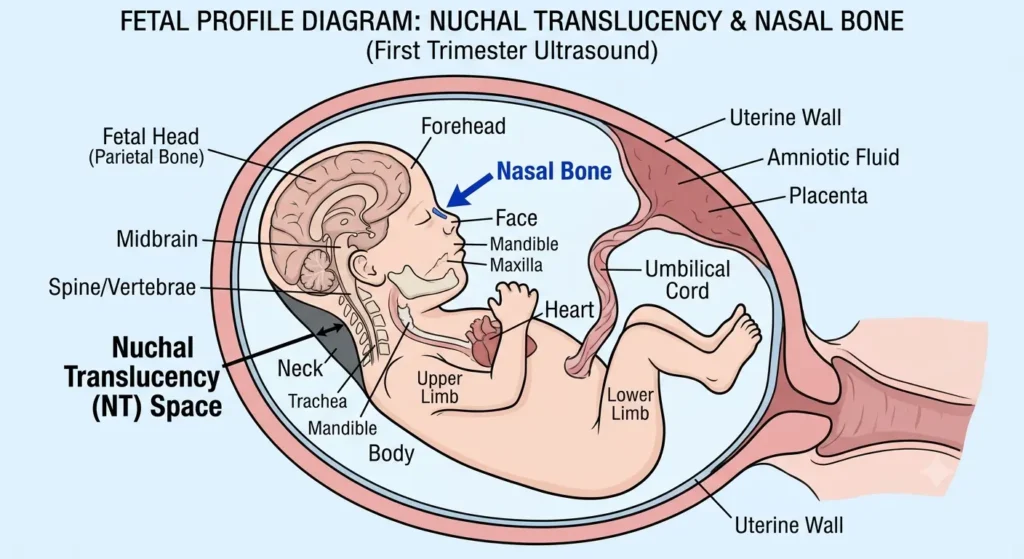
The NT-NB scan is a first-trimester ultrasound that looks at two specific things: the Nuchal Translucency (NT) and the Nasal Bone (NB).
Nuchal Translucency is the small, normal pocket of fluid that sits behind every baby’s neck in early pregnancy. Every baby has some fluid here the scan measures exactly how much.
The Nasal Bone is simply your baby’s developing nose bone. By this stage of pregnancy, it should be visible and forming normally on ultrasound.
Together, these two measurements help estimate the likelihood of certain chromosomal conditions, most commonly Down syndrome (Trisomy 21), as well as a few other rarer conditions.
Why Is This Scan Done?
Think of the NT-NB scan as a risk-assessment tool, not a diagnosis. It doesn’t tell you definitively whether your baby has a chromosomal condition it tells you whether your pregnancy falls into a lower-risk or higher-risk category, so your doctor can guide next steps if needed.
This matters because it lets most parents move forward reassured, while the small number who do need further testing can get it early, when there’s more time to make informed decisions.
It’s worth remembering: the vast majority of NT-NB scans come back completely normal, and that’s the end of the story for most parents.
This is exactly why regular prenatal checkups in early pregnancy matter so much.
When Is the NT-NB Scan Done?
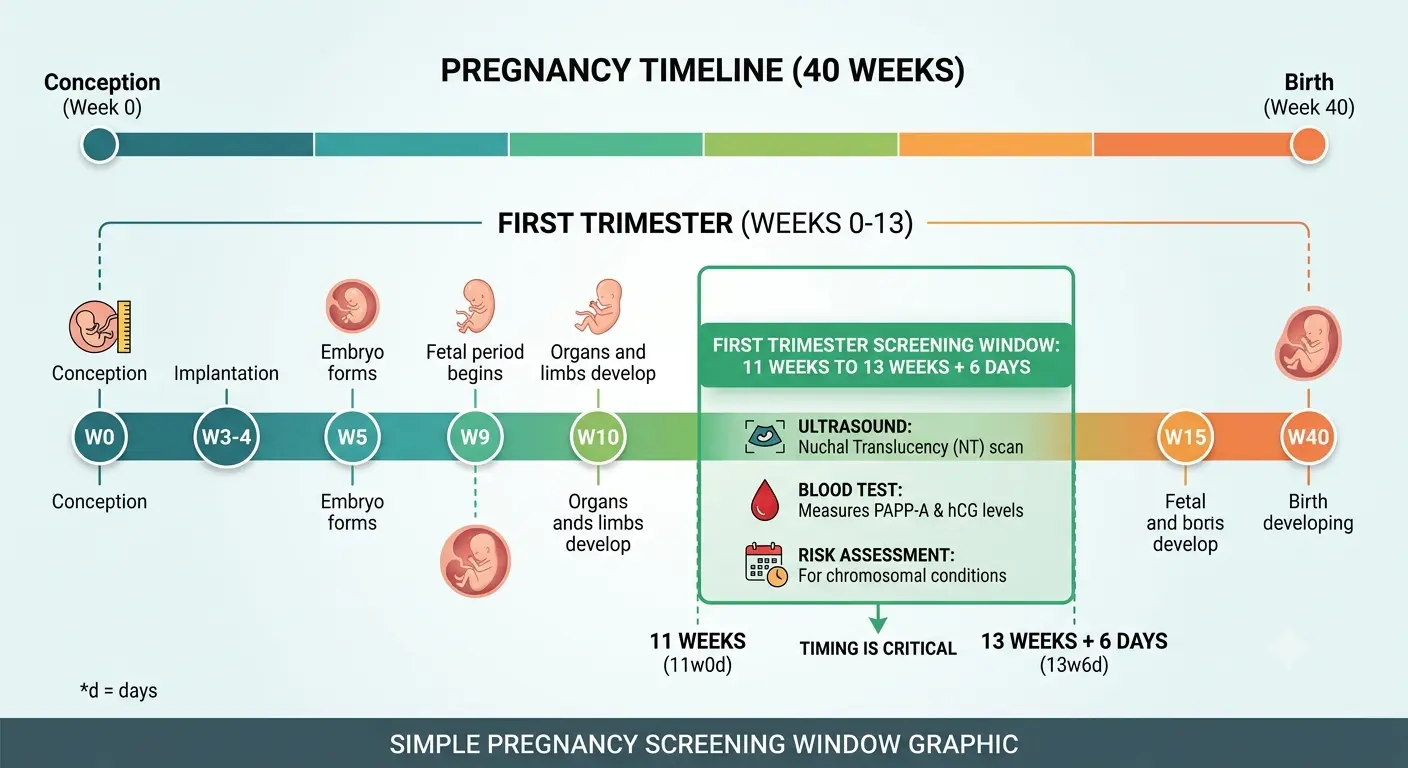
The scan has a specific timing window for a reason it’s done between 11 weeks and 13 weeks 6 days of pregnancy.
This window isn’t arbitrary. Too early, and your baby’s nasal bone hasn’t developed enough to assess accurately, which can lead to unreliable results. Too late, and the nuchal fluid naturally starts to reabsorb, which can also throw off the measurement.
Your doctor will typically use your baby’s crown-rump length (essentially, head-to-bottom length) to confirm you’re in the right window, rather than dates alone this is part of why the timing of your appointment matters.
What Happens During the Scan?
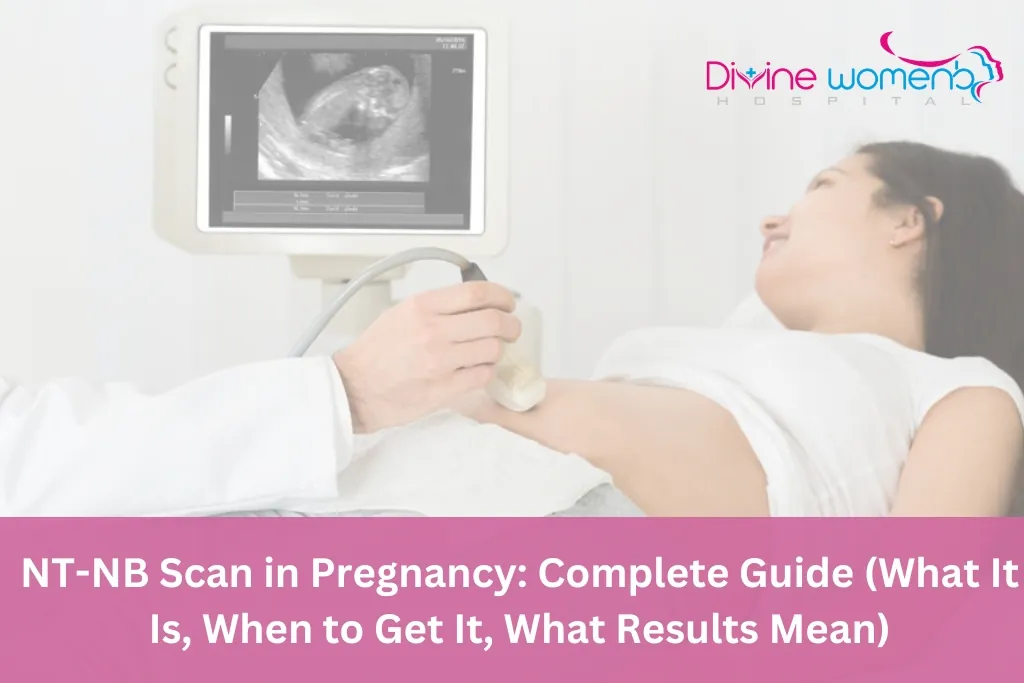
The NT-NB scan is done using ultrasound usually an abdominal (external) scan, though occasionally a transvaginal scan is used if a clearer image is needed, especially very early in the window.
The sonographer will position the probe to get a precise side-on view of your baby’s face and upper body, then carefully measure the fluid space behind the neck and check whether the nasal bone is visible.
This precision matters even a small measurement difference can change how results are interpreted, which is why NT-NB scans are typically performed by trained sonographers following standardized international protocols (from bodies like ISUOG and the Fetal Medicine Foundation).
The scan itself typically takes 15–30 minutes and is completely painless, similar to any other pregnancy ultrasound.
Understanding Your NT-NB Scan Results
This is usually where most of the anxiety comes in, so let’s break it down clearly.
Nuchal Translucency measurement: Your NT is measured in millimeters. What counts as “normal” isn’t a single fixed number it depends on your baby’s exact size (crown-rump length) at the time of the scan, since normal NT thickness naturally increases slightly as the scan window progresses. Your doctor or the report will factor this in for you.
Nasal bone: This is generally reported simply as present or not clearly visible at the time of scanning. If it’s not clearly visible, this isn’t automatically concerning timing, baby’s position, and even ethnic variation can all affect visibility this early, and it’s often rechecked on a follow-up scan before any conclusions are drawn.
Combined risk score: Most clinics combine your NT-NB results with a blood test (checking specific pregnancy hormones) and your age to generate an overall risk score, usually expressed as a ratio like 1 in 1,000 or 1 in 50. This combined approach is significantly more accurate than any single measurement alone.
Results are generally grouped into low risk, intermediate risk, or high risk categories, according to ISUOG’s patient guidance on Nuchal Translucency each category comes with a different recommended next step, which your doctor will walk you through based on your specific numbers.
If Your Results Show Increased Risk
If your results come back in the intermediate or high-risk range, take a breath this is a starting point for more information, not a diagnosis.
In fact, many babies with an elevated NT measurement turn out to be completely chromosomally normal. An increased risk score simply means your doctor may recommend additional testing to get more clarity.
This usually involves one or both of the following:
- Non-invasive prenatal testing (NIPT/cfDNA): A blood test that analyzes small fragments of your baby’s DNA circulating in your blood. It’s highly accurate for the most common chromosomal conditions and carries no risk to the pregnancy.
- Diagnostic testing (CVS or amniocentesis): These tests can confirm a diagnosis directly by examining fetal cells. They’re more invasive and typically reserved for higher-risk results or when NIPT isn’t sufficient on its own.
Your doctor will always explain which option makes sense for your specific situation there’s no one-size-fits-all next step, and you’re never obligated to pursue every available test.
How Accurate Is the NT-NB Scan?
No screening test is 100% certain, and it helps to understand what “accuracy” actually means here.
NT measurement alone catches a meaningful portion of Down syndrome cases. Adding nasal bone assessment and blood work substantially improves detection accuracy while also reducing unnecessary false alarms compared to NT alone which is exactly why combining these markers has become the modern clinical standard.
It’s also worth knowing that a certain percentage of low-risk pregnancies can still occasionally have false reassuring results, and a percentage of higher-risk results turn out to involve a chromosomally normal baby. This is precisely why the scan is called a screening test, not a diagnostic one and why further testing exists for anyone who wants more certainty.
In some cases, your doctor may also recommend a Doppler ultrasound alongside NT-NB screening for a fuller picture.
NT-NB Scans in Twin Pregnancies
If you’re expecting twins, the NT-NB scan still applies, but it’s assessed slightly differently each baby’s NT and nasal bone are evaluated individually, giving you baby-specific results rather than one combined number.
This is particularly useful in twin pregnancies, since ultrasound-based screening tends to be more reliable here than blood-test-based screening, which can be harder to interpret accurately with two placentas involved.
Frequently Asked Questions
Conclusion
What to expect at Divine Women's Hospital
Choosing where to be cared for is a personal decision, and it usually comes down to one question: will someone actually listen to me? At Divine Women's Hospital, that is where every consultation begins. Our senior consultants stay with you from the first visit through recovery, so you never have to repeat your story to a new face.
One consultant, start to finish
The doctor who examines you is the doctor who plans your treatment and performs your procedure. Continuity is not a luxury here, it is the baseline.
Explained in plain language
Reports are walked through line by line, in Gujarati, Hindi or English, until the plan makes sense to you and the family member sitting beside you.
Modern theatre and imaging under one roof
Laparoscopy suites, fetal-medicine grade ultrasound, NICU support and 24x7 emergency cover mean fewer referrals and less waiting between steps.
Honest, itemised costs
You receive a written estimate before admission. If the plan changes, we tell you why before anything is done.
Related Reads

22 September 2026
Pregnancy Diet & Nutrition Guide: Calories, Key Nutrients, and Foods to Avoid by Trimester
What you eat during pregnancy shapes fetal organ development, placental function, and your own metabolic health - but “eating for two” is a myth. Here is how many calories you actually need each trimester, which nutrients matter most, and the foods to avoid.
Read more
26 July 2026
Best Fertility Treatments for PCOS: Complete Guide
If you have PCOS and you’re trying to conceive, you’ve probably felt like the information out there is either too simple (“just lose weight!”) or too overwhelming (a dozen treatment names you’ve never heard of). The reality sits in between.
Read more
20 July 2026
Vaginal Discharge Types, Colors & Causes: Complete Guide for Women
If you’ve ever paused mid-day, worried about a change in your discharge, you’re not alone. Almost every woman notices some kind of vaginal discharge at some point – and almost every woman has, at least once, wondered if it’s normal.
Read moreWe are here for you
Book a consultation with our women's health team in Ahmedabad
Obstetricians, gynecologists, fertility specialists and a neonatologist, with hospital staff available 24×7 for you and your baby.