
NT-NB Scan Results Explained: What Do High-Risk and Low-Risk Reports Mean?
This article is written by our clinical team for the women and families we meet every day. It is meant to inform you, not to replace a consultation, and every recommendation here is one we would give you in the room.
Introduction
You just got your NT-NB scan report back, and there’s a number on it that’s making your heart race.
Maybe it says “1:180.” Maybe it says “high risk.” Maybe your doctor used a word like “flagged” and moved on before you could ask what that actually means for your baby.
Take a breath. A screening report is not a diagnosis and understanding what these numbers actually mean can turn a scary piece of paper into useful information you can act on with confidence.
This guide walks you through exactly how to read your NT-NB scan result, what “high-risk” and “low-risk” really mean in practice, and what your next steps look like either way.
First, a Quick Recap: What Is This Report Actually Measuring?
Your NT-NB scan (done between 11 and 14 weeks) measures two things on ultrasound: the fluid layer at the back of your baby’s neck (nuchal translucency, or NT) and whether the tiny nasal bone is visible and well-formed.
These measurements are combined with your age and two blood markers (PAPP-A and free beta-hCG) to calculate a personalized risk score for conditions like Down syndrome (trisomy 21), Edwards syndrome (trisomy 18), and Patau syndrome (trisomy 13).
If you haven’t read our full breakdown of how the scan itself works, our guide on what an NT scan actually measures and how it’s performed covers that in detail. This article picks up exactly where that one leaves off at the report in your hands.
Understanding the Number: What Does “1 in 250” Actually Mean?
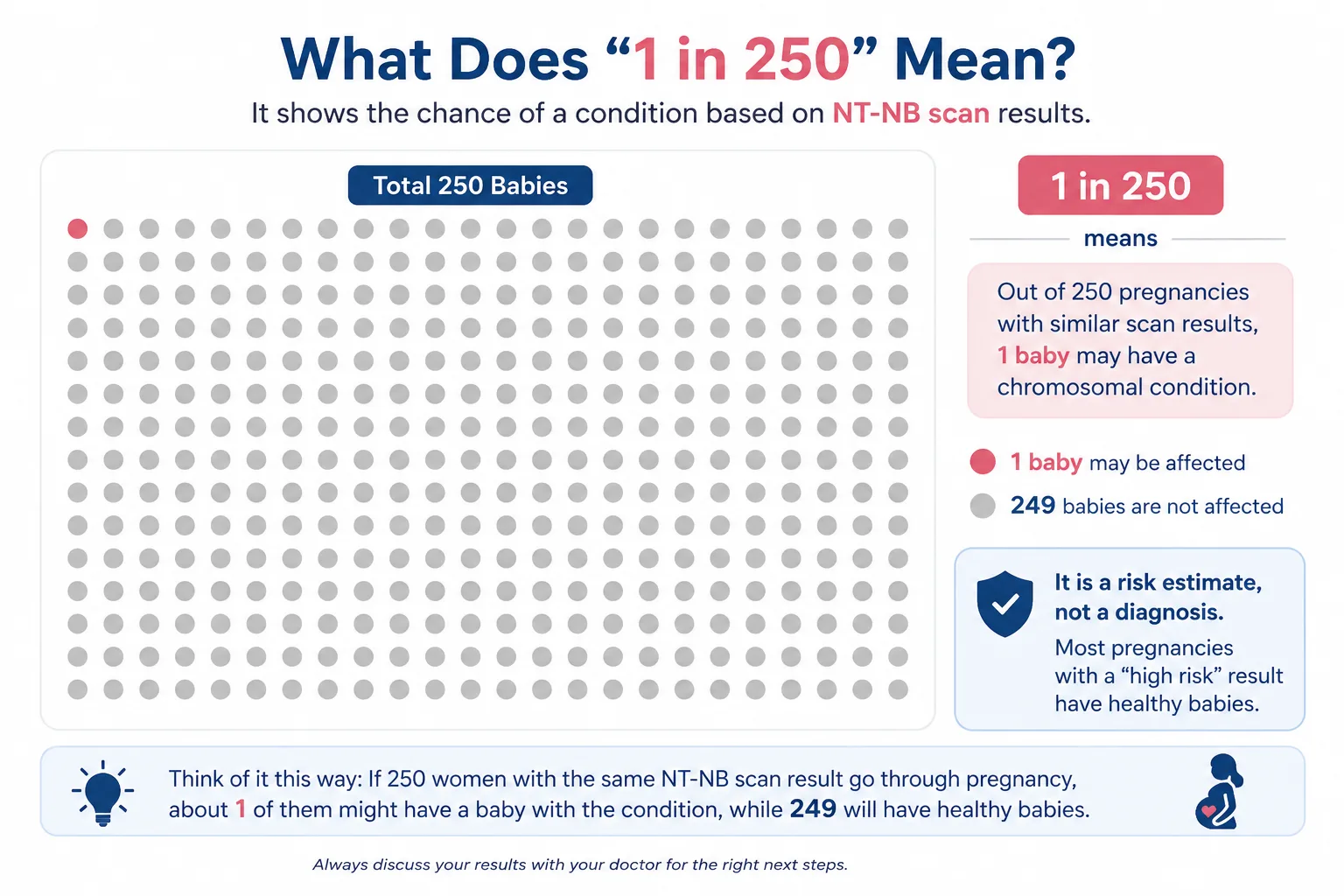
Your report won’t say “safe” or “unsafe.” It will show a ratio, like 1:250 or 1:2,500.
This ratio simply means: among 250 pregnancies with your exact combination of age and test results, statistically about 1 would have the condition being screened for and 249 would not.
A smaller second number means lower risk. “1:2,500” is far lower risk than “1:150,” even though both start with “1 in.”
Most labs draw a line commonly around 1:250 above which a result is labeled “high risk,” and below which it’s labeled “low risk.” Ask your doctor exactly where your lab sets that line, because it does vary slightly between labs.
A Worked Example, So the Number Actually Makes Sense
Let’s say you’re 30, and your report shows a Down syndrome risk of 1:1,000.
For context, a 30-year-old’s baseline age-related risk (before any scan) is also around 1:1,000 so this result hasn’t shifted your odds much either way. That’s a genuinely low-risk report.
Now say your NT-NB scan and blood markers together push that same starting point up to 1:55. That’s still less than a 2% chance overall but it has crossed most labs’ high-risk threshold, so it gets flagged and prompts a conversation about next steps.
This is the part that trips people up: even a “high-risk” report usually still describes a fairly low absolute chance. What changed is the degree of certainty, not necessarily the outcome.
Why Two Women With the Same Number Can Get Different Advice
Not every lab uses the same cutoff. Some set the high-risk line at 1:150, others at 1:250, others at 1:300.
This means two women with technically similar risk numbers could be told different things depending on which lab or hospital protocol calculated their score. Neither approach is “wrong” labs are simply choosing different balances between catching more true cases and generating fewer false alarms.
This is exactly why it’s worth asking your doctor directly: “What cutoff did this lab use, and where does my number fall relative to it?” A number in isolation means less than the number in context.
Beyond Down Syndrome: What Else This Screening Can Flag
While Down syndrome (trisomy 21) is the main focus, the same NT-NB combined screen also estimates risk for:
- Trisomy 18 (Edwards syndrome) : often shows a similarly increased NT, sometimes with additional ultrasound findings
- Trisomy 13 (Patau syndrome) : also associated with increased NT and specific markers
If either of these is flagged, the follow-up approach is essentially the same as for Down syndrome: genetic counseling, and the option of a confirmatory test.
There’s one more thing worth knowing: a significantly enlarged NT measurement, even in a baby whose chromosomes later test normal, is on its own a reason for a closer look at the heart specifically, since enlarged NT has an independent association with structural heart differences. This is a separate reason your doctor may still recommend a detailed scan even after a normal chromosomal result.
What This Screening Does Not Cover
It’s just as important to know what NT-NB screening isn’t designed to catch. It does not screen for neural tube defects (that’s a separate blood marker, done later), most single-gene disorders, or every possible structural condition.
This is exactly why the mid-pregnancy anatomy scan remains a standard part of every pregnancy’s care the two scans are designed to complement each other, not duplicate each other.
What “High-Risk” Actually Means (and What It Doesn’t)
Here’s the part almost nobody explains clearly enough: a high-risk screening result is not a diagnosis.
It means your calculated probability crossed the lab’s threshold nothing more. In fact, the majority of “high-risk” screening results turn out to be false alarms once confirmed with further testing.
Think of it this way: if your report says 1:50, that’s genuinely worth following up on but it also means a 98% chance your baby does not have the condition. The label “high-risk” describes a relative shift in probability, not a verdict.
That said, a high-risk flag is a real and valid reason to take the next step: confirmatory testing.
What “Low-Risk” Actually Means (and Its One Limitation)
A low-risk result means your calculated probability is below the lab’s cutoff this is reassuring, and for the vast majority of women, no further testing is needed.
The one honest caveat: no screening test is 100% sensitive. A low-risk result significantly reduces the chance of a problem, but it does not reduce it to exactly zero.
This is exactly why every pregnancy, regardless of NT-NB result, still gets a detailed anatomy ultrasound around 18–20 weeks it’s a second layer of reassurance, not a sign something was missed.
If Your Result Is High-Risk: Your Next Steps
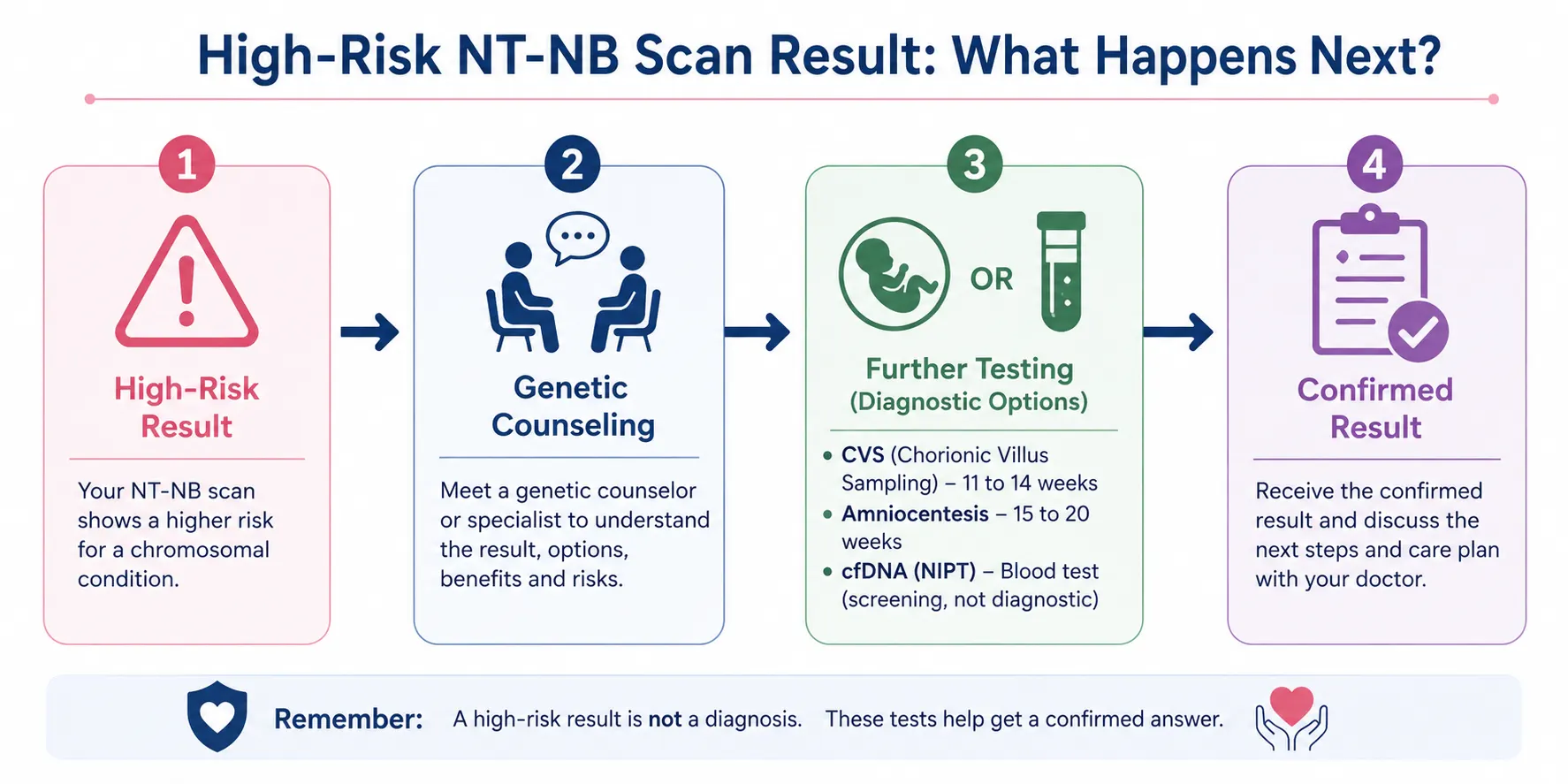
1. Talk to a genetic counselor or your high-risk pregnancy specialist. This is the single most useful next step. A specialist can walk through your exact number, your specific risk factors, and what it means in plain terms. Our high-risk pregnancy care team, led by Dr. Devang Patel, supports patients through exactly this conversation.
2. Consider a confirmatory test. Two paths are usually offered:
- CVS (Chorionic Villus Sampling) : done around 10–13 weeks, gives a definitive answer earlier
- Amniocentesis : done from 15 weeks onward, also definitive
Both carry a very small procedure-related risk, which is why some women choose to first do a non-invasive cfDNA blood test to further narrow the picture before deciding on an invasive test. Per ACOG’s current screening guidance, every patient has the right to choose or decline any of these follow-up options after counseling; there’s no single “correct” path that applies to everyone.
3. Expect a more detailed ultrasound. A high NT reading on its own even separate from chromosomal results is a reason for a closer structural look, particularly at the heart. Our Doppler and detailed ultrasound monitoring protocols are built for exactly this kind of closer follow-up.
4. Give yourself room to process it. It’s completely normal to feel anxious here. Ask every question you have. Bring your partner or a support person to the follow-up conversation. There is no “wrong” pace for deciding your next step.
If Your Result Is Low-Risk: What Happens Next
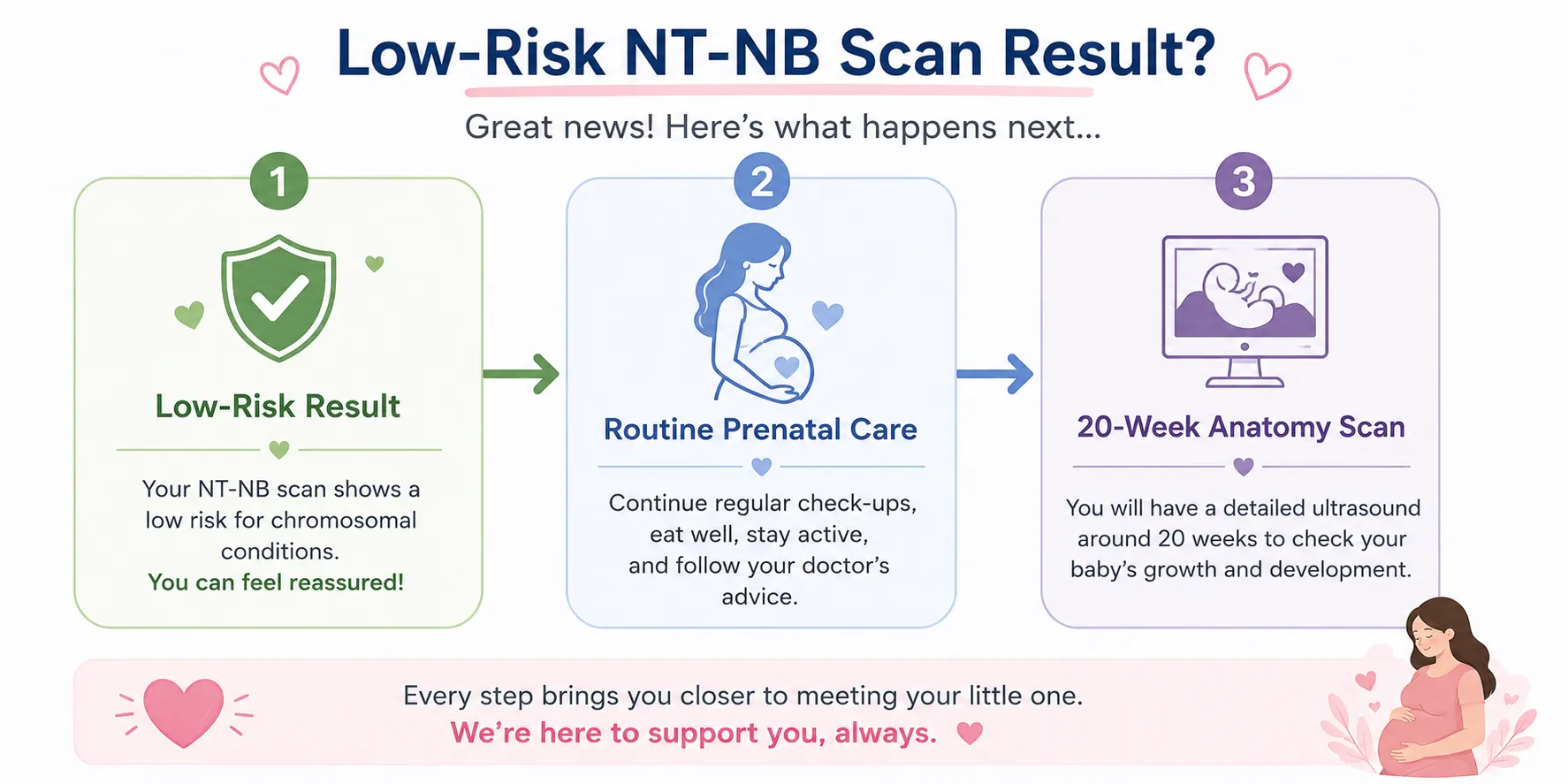
For most women, a low-risk result means simply continuing with your regular prenatal schedule no extra tests, no extra appointments.
Your care plan continues as normal, including your routine prenatal checkups and the mid-pregnancy anatomy scan around 18–20 weeks.
Why Your Doctor Sometimes Combines This With a Second Blood Test
Some care plans don’t stop at the first-trimester result they add a second-trimester blood test and recombine the data for a more refined final number. If your doctor mentions “integrated” or “sequential” screening, this is what they mean, and it’s simply a way of narrowing the estimate further, not a sign anything is wrong with your first result.
A Note on Why Screening and Diagnosis Are Different Things
It helps to think of NT-NB screening as a smoke detector, not a fire inspector.
A smoke detector tells you the probability of smoke is elevated enough to check further it doesn’t tell you there’s definitely a fire. CVS, amniocentesis, and cfDNA testing are the “fire inspectors” they look directly at the source and give you a definitive answer.
Screening exists to help you decide, with real numbers, whether that closer look is worth pursuing for your specific pregnancy.
Frequently Asked Questions
Why families across Gujarat trust Divine Women's Hospital
Choosing where to be cared for is a personal decision, and it usually comes down to one question: will someone actually listen to me? At Divine Women's Hospital, that is where every consultation begins. Our senior consultants stay with you from the first visit through recovery, so you never have to repeat your story to a new face.
One consultant, start to finish
The doctor who examines you is the doctor who plans your treatment and performs your procedure. Continuity is not a luxury here, it is the baseline.
Explained in plain language
Reports are walked through line by line, in Gujarati, Hindi or English, until the plan makes sense to you and the family member sitting beside you.
Modern theatre and imaging under one roof
Laparoscopy suites, fetal-medicine grade ultrasound, NICU support and 24x7 emergency cover mean fewer referrals and less waiting between steps.
Honest, itemised costs
You receive a written estimate before admission. If the plan changes, we tell you why before anything is done.
Related Reads

17 October 2026
Vaginal Birth Recovery: Soreness, Discharge & Afterpains Explained
Uterine afterpains, lochia stages and perineal healing all follow a predictable timeline after a vaginal birth. What is normal week by week, and the handful of warning signs that mean you should call your provider rather than wait.
Read more
14 August 2026
What Is an NT Scan in Pregnancy? Purpose, Timing & Procedure Explained
If someone just mentioned “NT scan” at your prenatal visit and you nodded along without fully understanding it, you’re in good company. It’s one of those terms doctors use daily that rarely gets fully explained to patients.
Read more
7 April 2026
Doppler Ultrasound in High-Risk Pregnancy Explained
Pregnancy is a beautiful journey, but for some women, it may come with complications that require closer monitoring. In such cases, doppler ultrasound in high risk pregnancy plays a vital role in ensuring the health and safety of both mother and baby.
Read moreWe are here for you
Book a consultation with Ahmedabad's trusted women's health team
Internationally certified obstetricians, gynecologists and fertility specialists, available 24×7 for you and your baby.