
What Is an NT Scan in Pregnancy? Purpose, Timing & Procedure Explained

This article is written by our clinical team for the women and families we meet every day. It is meant to inform you, not to replace a consultation, and every recommendation here is one we would give you in the room.
If someone just mentioned “NT scan” at your prenatal visit and you nodded along without fully understanding it, you’re in good company. It’s one of those terms doctors use daily that rarely gets fully explained to patients.
Here’s the short version: it’s a quick, safe ultrasound done early in pregnancy that helps estimate your baby’s chance of certain chromosomal conditions. It doesn’t diagnose anything - it simply helps your doctor understand your pregnancy’s risk profile. For the full picture, our NT-NB Scan in Pregnancy: Complete Guide covers everything end to end.
This guide walks through exactly what it is, why it’s recommended, when to schedule it, and what actually happens during the appointment so you know what to expect before you go in.
What Does “NT” Actually Stand For?
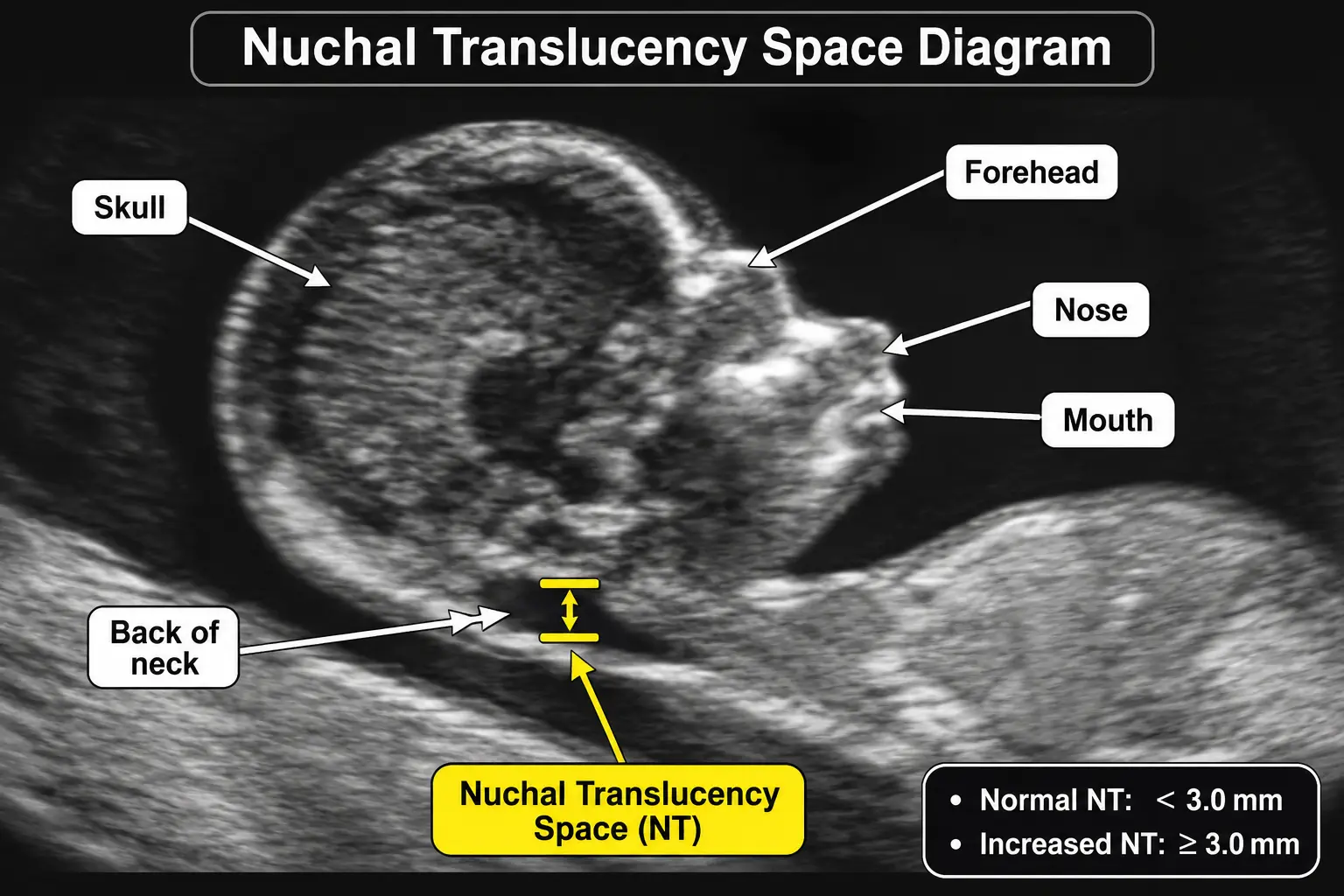
NT stands for Nuchal Translucency a slightly technical name for something simple. It refers to the small, fluid-filled space at the back of every baby’s neck, visible on ultrasound in early pregnancy.
Every baby has some fluid here; it’s a completely normal part of development. The scan simply measures exactly how much fluid is present, in millimeters.
That measurement matters because babies with certain chromosomal conditions most commonly Down syndrome tend to have slightly more fluid in this space, on average, than babies without.
Why Do Doctors Recommend the NT Scan?
The NT scan exists to give expecting parents an early, low-risk way to understand their pregnancy’s chance of a chromosomal condition well before more invasive testing would typically happen.
On its own, the NT measurement is a useful clue, but not the full picture. That’s why it’s usually combined with a blood test (checking two specific pregnancy hormones) and your age to calculate a more accurate overall risk score this combination is often called the “combined first-trimester screen.”
According to ACOG’s patient guidance on prenatal genetic screening, this combined approach is offered to essentially all pregnant patients today, precisely because it’s safe, non-invasive, and provides meaningful early information.
It’s worth repeating: this is a screening test, not a diagnosis. A normal result is reassuring; an elevated result simply means your doctor will likely suggest a closer look, not that anything is definitely wrong.
When Should You Get an NT Scan?
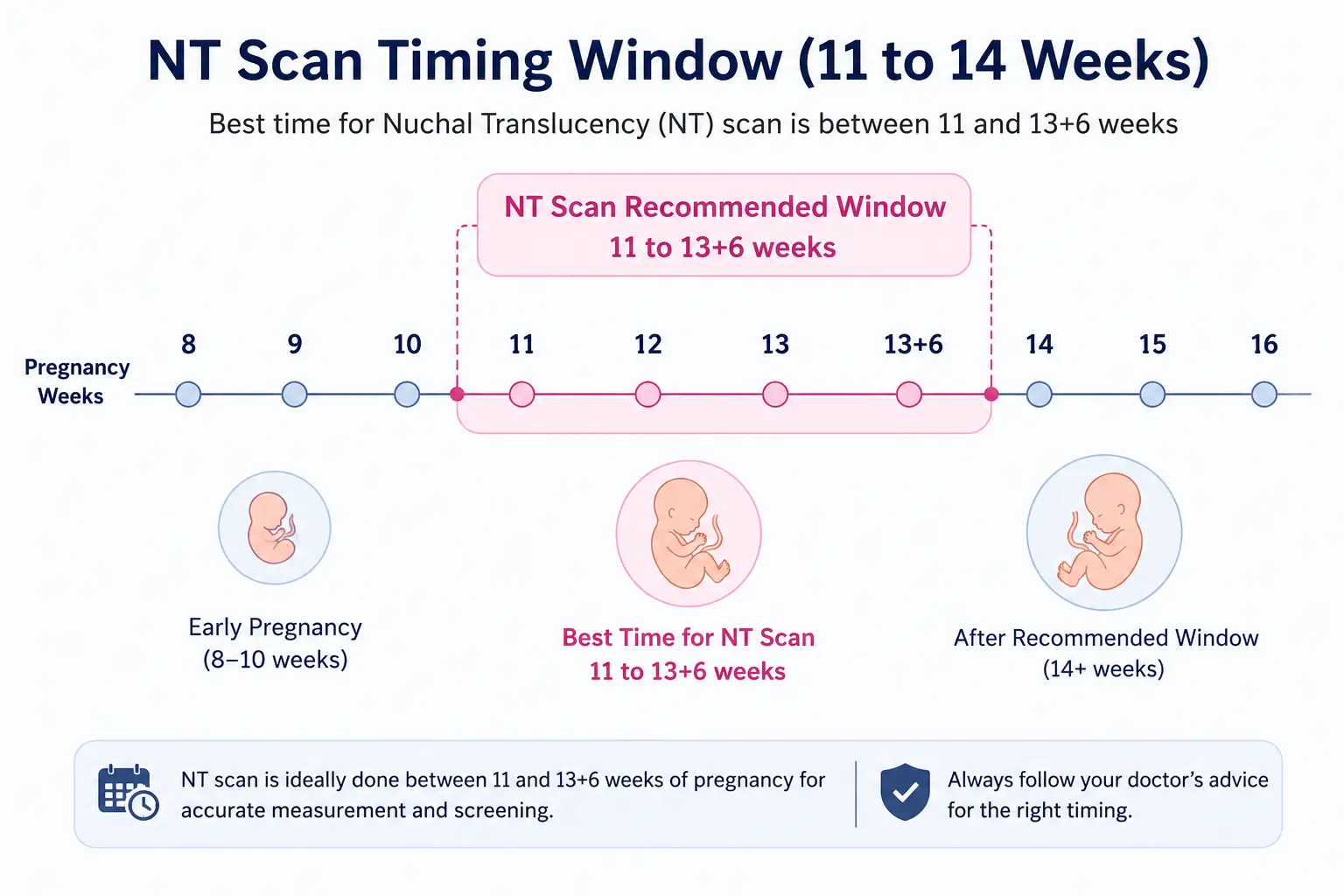
Timing matters more with this scan than with most other pregnancy ultrasounds. The window is specific: 11 weeks 0 days through 13 weeks 6 days of pregnancy.
Doctors don’t pick this window arbitrarily. Earlier than 11 weeks, your baby is simply too small to measure the nuchal space reliably. Later than 14 weeks, the fluid naturally starts reabsorbing, which throws off the accuracy of the reading.
Most specialists consider 12 to 13 weeks the sweet spot your baby is large enough to image clearly, but the measurement window is still fully open.
If you happen to miss this window, you’re not out of options. Your doctor may recommend a different screening approach instead, like a second-trimester blood test or NIPT (a blood-based screening test), depending on how far along you are.
What Actually Happens During the Appointment?

Knowing what to expect can make the whole visit feel a lot less unfamiliar. Here’s the typical flow.
Before the scan: Preparation is minimal. Some clinics ask you to arrive with a reasonably full bladder, since this actually improves how clearly the uterus shows up on ultrasound. Loose, two-piece clothing makes things easier for the abdominal scan.
During the scan: A trained sonographer applies gel to your lower abdomen and uses the ultrasound probe to get a precise side profile view of your baby including the forehead, nose, spine, and neck. This positioning matters, since an inaccurate angle can affect the measurement.
The measurement itself: Once positioned correctly, the sonographer places measurement markers on the translucent space at the back of the neck. This takes just seconds, though getting your baby into the right position first can take a little longer. Most sonographers take a few measurements and use the most accurate one.
If needed: Occasionally, if the abdominal view isn’t clear enough due to baby’s position or early gestational timing a transvaginal scan may be used instead for a closer, clearer view.
The whole appointment usually takes 15 to 30 minutes, and it’s painless you may feel some pressure if your bladder is full, but you won’t feel the ultrasound itself at all.
Who Performs the NT Scan, and Does It Matter?
Yes, it genuinely does. NT scans require real precision even a difference of half a millimeter in the measurement can shift the calculated risk score meaningfully.
Because of this, NT scans should be performed by sonographers or fetal medicine specialists with specific training in this measurement technique, following internationally standardized imaging protocols (from bodies like ISUOG).
This is one of those situations where experience genuinely affects accuracy, which is part of why it’s worth having this scan done at a center with dedicated fetal medicine expertise rather than a general ultrasound clinic.
What Comes After the Scan?
Once your scan is done, the NT measurement is typically combined with your blood test results and age to generate an overall risk score usually shown as a ratio, like “1 in 800” or “1 in 150.”
If your combined result falls in the low-risk range, you’ll generally continue with routine prenatal care, including your regular anatomy scan later in pregnancy.
If it falls in the higher-risk range, your doctor will likely walk you through further options usually a more detailed blood test (NIPT) or, in some cases, diagnostic testing. We cover exactly how to read and understand your results in a dedicated guide, since that deserves its own detailed explanation.
Frequently Asked Questions
No, it’s optional but widely recommended as part of routine first-trimester care. You’re always free to discuss whether it’s right for you with your doctor.
Conclusion
The NT scan is a quick, safe, and genuinely useful part of early pregnancy care designed to give you information, not worry. Understanding what it checks and why makes the appointment feel far more routine than mysterious.
If you’re due for your NT scan or have questions about scheduling one, the team at Divine Women’s Hospital, Ahmedabad, is happy to walk you through it.
Why families across Gujarat trust Divine Women's Hospital
Choosing where to be cared for is a personal decision, and it usually comes down to one question: will someone actually listen to me? At Divine Women's Hospital, that is where every consultation begins. Our senior consultants stay with you from the first visit through recovery, so you never have to repeat your story to a new face.
One consultant, start to finish
The doctor who examines you is the doctor who plans your treatment and performs your procedure. Continuity is not a luxury here, it is the baseline.
Explained in plain language
Reports are walked through line by line, in Gujarati, Hindi or English, until the plan makes sense to you and the family member sitting beside you.
Modern theatre and imaging under one roof
Laparoscopy suites, fetal-medicine grade ultrasound, NICU support and 24x7 emergency cover mean fewer referrals and less waiting between steps.
Honest, itemised costs
You receive a written estimate before admission. If the plan changes, we tell you why before anything is done.
Related Reads
7 April 2026
Doppler Ultrasound in High-Risk Pregnancy Explained
Pregnancy is a beautiful journey, but for some women, it may come with complications that require closer monitoring. In such cases, doppler ultrasound in high risk pregnancy plays a vital role in ensuring the health and safety of both mother and baby.
Read more
29 September 2026
Gestational Diabetes: Causes, Risks & Management During Pregnancy
Gestational diabetes now affects roughly 1 in 7 pregnancies worldwide - but a GDM diagnosis is highly manageable, not a foregone complication. Diagnostic criteria, glucose targets, medication options and postpartum follow-up explained.
Read more
22 September 2026
Signs You Need a High-Risk Pregnancy Specialist
Most pregnancies proceed without needing subspecialty care - but certain medical histories, symptoms, and test results signal that a Maternal-Fetal Medicine specialist should be part of your care team.
Read moreWe are here for you
Book a consultation with Ahmedabad's trusted women's health team
Internationally certified obstetricians, gynecologists and fertility specialists, available 24×7 for you and your baby.