Introduction
If your doctor has mentioned NT-NB scan, Double Marker test, and NIPT all in the same conversation, you’re not alone in feeling a little overwhelmed.
They all claim to screen for similar things so which one do you actually need?
The honest answer: it depends on your age, your budget, your timeline, and what you personally want out of the result. This guide breaks down exactly how these tests differ, so you can have an informed conversation with your doctor instead of just picking whichever name sounds most reassuring.
If you haven’t already, it’s worth first reading what an NT scan actually measures and how it’s performed and how to interpret your NT-NB scan report — this article builds directly on both.
The One Rule Doctors Want You to Know First
Before comparing options, there’s one principle worth internalizing: you’re meant to choose one primary screening strategy, not stack multiple tests together.
Doing several screening tests at once doesn’t make the result more accurate it usually just adds more false alarms, more confusion, and more anxiety, without giving you a clearer answer. The goal of this guide is to help you pick the right one test for your situation, not to convince you to do all three.
A Quick Refresher: What Each Test Actually Is
NT-NB Scan (Nuchal Translucency + Nasal Bone) An ultrasound done between 11 and 14 weeks that measures fluid behind your baby’s neck and checks the nasal bone. Often combined with a blood test (see “First-Trimester Combined Screening” below).
Double Marker Test A blood test done between 9 and 14 weeks measuring two markers free beta-hCG and PAPP-A. On its own, it’s a blood-only test; combined with the NT-NB scan, it becomes “Combined Screening.”
NIPT (Non-Invasive Prenatal Testing) A blood test, usable from about 9–10 weeks onward, that directly analyzes tiny fragments of placental DNA circulating in your blood. It’s the newest and most sophisticated of the three.
Side-by-Side Comparison
| NT-NB Scan (Ultrasound only) | Double Marker (Blood only) | Combined Screening (NT-NB + Double Marker) | NIPT (cfDNA blood test) | |
|---|---|---|---|---|
| Timing | 11–14 weeks | 9–14 weeks | 11–14 weeks | 9–10 weeks onward |
| What it checks | Neck fluid + nasal bone via ultrasound | Two blood markers | Ultrasound + blood combined | Fetal DNA fragments in maternal blood |
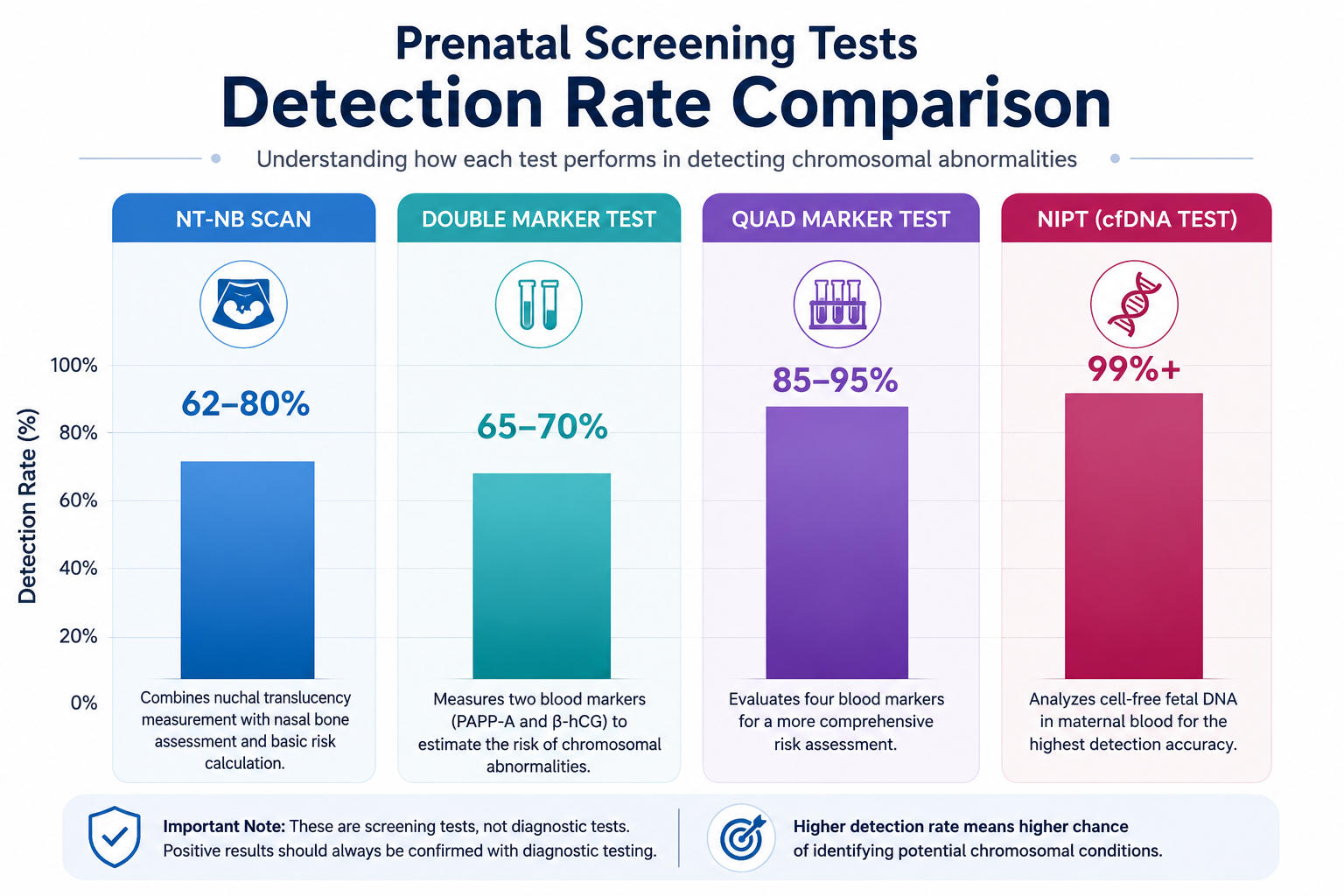
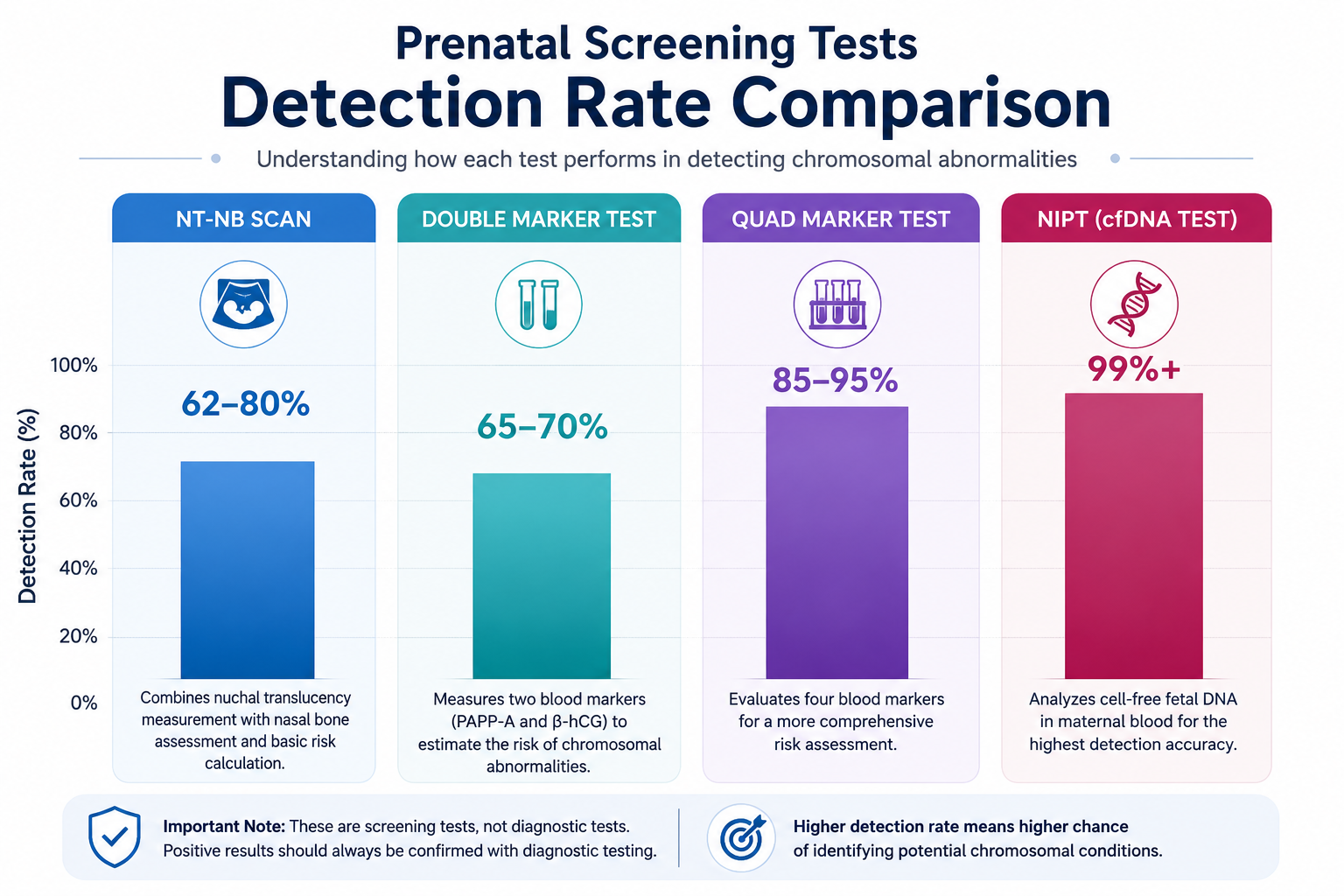
| Down syndrome detection | ~62–80% | ~65–70% | ~85–95% | >99% |
| False alarm rate | ~5% | ~5% | ~2.7–5% | ~0.04–0.13% |
| Also flags | Early structural/cardiac risks | Preeclampsia-risk hints | Both of the above | Sex-chromosome conditions, some microdeletions |
| Typical cost tier | Moderate | Lower | Moderate | Higher |
| Best suited for | Anatomical baseline + risk estimate | Budget-conscious add-on to NT scan | Most average-risk pregnancies | Highest accuracy seekers, advanced maternal age |
Why NIPT’s Numbers Look So Much Better and the Catch
Looking purely at detection rates, NIPT wins by a wide margin over 99% for Down syndrome, compared to roughly 85–95% for Combined Screening.
Its false-alarm rate is also dramatically lower often under 0.1%, versus roughly 3–5% for combined ultrasound-and-blood screening.
Here’s the catch worth understanding: NIPT is still a screening test, not a diagnosis. A positive NIPT result still needs to be confirmed with CVS or amniocentesis before any irreversible decision is made the DNA it analyzes comes from the placenta, not directly from your baby, and placental and fetal DNA don’t always perfectly match. Per ACOG’s current screening guidance, every patient should be counseled that any positive screening result regardless of which test produced it needs diagnostic confirmation before major decisions are made.
There’s a second catch: NIPT cannot replace the ultrasound. It tells you about chromosome numbers, not about your baby’s physical structure. If your NT measurement itself is significantly enlarged, that’s an independent signal one that NIPT alone won’t catch pointing toward heart defects or other structural conditions that need a closer look regardless of what your NIPT result says.
Why Some Doctors Still Recommend Combined Screening Over NIPT
If NIPT is more accurate, why doesn’t everyone just get NIPT?
1. The ultrasound catches things NIPT can’t. The NT-NB scan gives you an early anatomical baseline — confirming your due date, checking viability, and in twin pregnancies, establishing how the placentas are arranged. None of that comes from a blood draw.
2. Cost and accessibility. Combined Screening is generally more affordable and more widely available than NIPT, which matters for many families.
3. It’s genuinely accurate for most situations. For an average-risk pregnancy, Combined Screening’s 85–95% detection rate is still considered clinically solid — it’s not a weak test, it’s simply not as strong as NIPT specifically for the common trisomies.
When NIPT Is Usually the Stronger Choice
- Advanced maternal age (35+) : your baseline probability of a chromosomal condition is higher, so NIPT’s superior accuracy carries more real-world value
- A prior pregnancy affected by a chromosomal condition
- You want to minimize the chance of a false alarm : if a Combined Screening “high-risk” flag would send you straight into weeks of anxiety, NIPT’s much lower false-positive rate may be worth the extra cost
- Twin pregnancies : NIPT has held up well in twin studies, while blood-only tests like the Double Marker perform noticeably worse in twins
When Combined Screening (NT-NB + Double Marker) Still Makes Sense
- You want the anatomical/structural information the ultrasound provides
- Budget is a genuine factor in your decision
- You’re at average risk with no specific red flags in your history
- Your doctor wants an early structural baseline regardless of which blood test you choose
What About the Double Marker Test Alone (No Ultrasound)?
Used by itself, the Double Marker test is the least accurate of the group its detection rate drops to roughly 65–70% without the ultrasound component. It’s rarely recommended as a standalone strategy; it’s meant to be paired with the NT-NB scan for a meaningfully better result.
What If You’ve Already Missed the First-Trimester Window?
If you’re past 14 weeks, the NT-NB scan itself is no longer accurate it depends on a crown-rump length measurement that’s only valid up to about 13 weeks 6 days.
Two options remain open to you: NIPT, which stays usable from 9 to10 weeks all the way to term, or the Quadruple Marker test, a second-trimester blood test done between 15 and 20 weeks. The Quad screen checks four different markers and has one advantage neither NT-NB screening nor NIPT offers on its own: it also screens for open neural tube defects like spina bifida, by checking maternal AFP levels. If you’re past the first-trimester window and want that additional coverage, it’s worth discussing directly with your doctor.
Does Any of These Tests Replace the 20-Week Anatomy Scan?
No — and this trips up a lot of people. All three screening pathways (NT-NB, Combined, NIPT) focus specifically on chromosomal risk. None of them substitute for the detailed mid-pregnancy anatomy scan around 18–20 weeks, which evaluates your baby’s physical development structure by structure heart chambers, spine, kidneys, limbs, and more.
Think of first-trimester screening and the anatomy scan as two different layers of reassurance, not overlapping steps. Skipping one because you’ve done the other leaves a genuine gap in your prenatal care picture.
What About Twin Pregnancies, Specifically?
Twins deserve their own mention because standard blood-only screening performs noticeably worse here. Since analyte levels reflect the combined output of both placentas, a plain Double Marker test in a twin pregnancy loses meaningful accuracy and tends to flag more false alarms than it would in a single pregnancy.
NIPT has held up far better in twin studies, and SNP-based NIPT platforms can even distinguish identical from fraternal twins and estimate each baby’s individual genetic contribution — something no blood-marker-only test can do. If you’re expecting twins, this is a conversation worth having directly with your high-risk pregnancy specialist rather than defaulting to whichever test a general pregnancy checklist recommends.
If your NT-NB scan shows a markedly enlarged nuchal translucency, the recommended next step generally isn’t NIPT at all it’s usually a direct move to diagnostic testing (CVS or amniocentesis), plus a detailed follow-up scan of the heart and other structures.
This is because a significantly elevated NT is linked to a broader range of possible conditions including some structural and genetic syndromes that fall outside what any blood-based screening test, including NIPT, is designed to detect. Our high-risk pregnancy care team guides families through exactly this kind of decision.
Making Sense of a “Positive” Result, Whichever Test You Choose
One number matters more than most people realize: your age changes how much weight a positive result actually carries.
For a younger patient with a lower baseline risk, a positive Combined Screening result might mean only a 2–5% real chance of an affected pregnancy the vast majority turn out fine. A positive NIPT in the same patient carries meaningfully more weight, often in the 40–60% range, because NIPT’s accuracy is so much higher.
For an older patient with a higher baseline risk, both tests carry more predictive weight when positive which is part of why age is such a central factor in this decision.
This is exactly why a positive result from any of these tests should lead to a conversation with your doctor about confirmatory testing not immediate panic.
Our Recommendation Framework
| Your Situation | Consider |
|---|---|
| Average-risk, budget-conscious, want an early anatomical scan | Combined Screening (NT-NB + Double Marker) |
| 35+, prior affected pregnancy, or want maximum accuracy | NIPT |
| Twin pregnancy | NIPT (preferably SNP-based) or Combined Screening, discussed with your doctor |
| NT measurement significantly enlarged on ultrasound | Skip straight to diagnostic testing conversation, regardless of blood test choice |
| Presenting after 14 weeks (missed the first-trimester window) | NIPT (still usable) or the second-trimester Quadruple Marker test |
Whichever path fits you, the right next step is the same: talk it through with your doctor before deciding, factoring in your specific history not just the numbers on a comparison chart. For continued care and routine prenatal checkups after your screening choice, our team is here to guide you through each stage.