
HSG Test for Blocked Fallopian Tubes: Procedure, Pain, Results and Next Steps
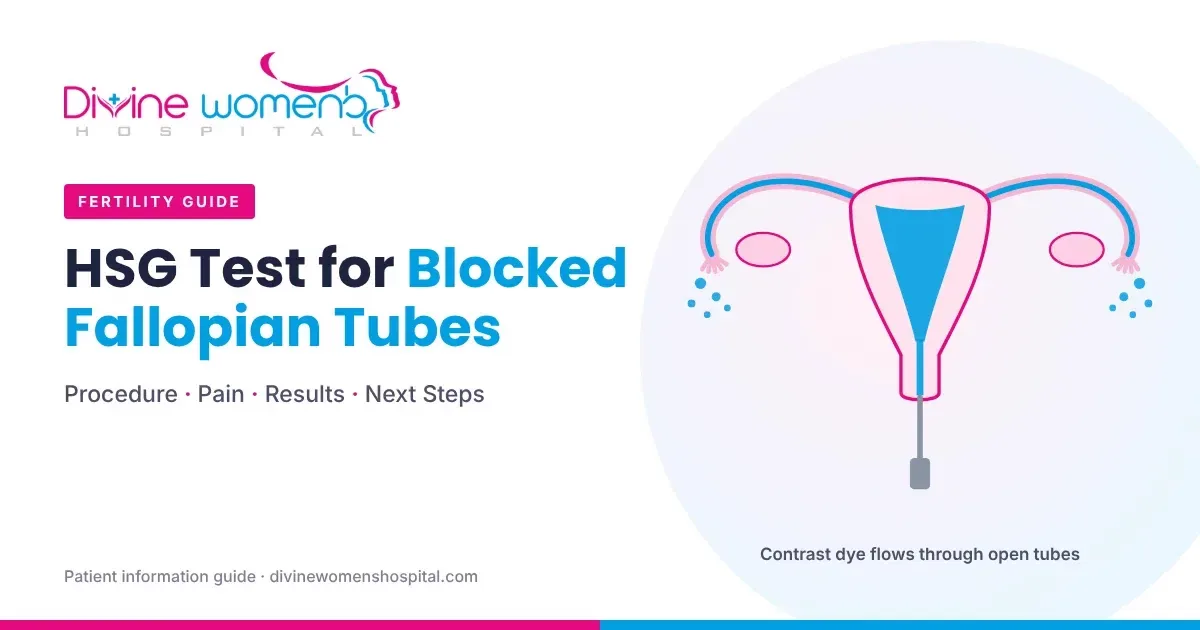
This article is written by our clinical team for the women and families we meet every day. It is meant to inform you, not to replace a consultation, and every recommendation here is one we would give you in the room.
Medically reviewed by Dr. Devang Patel, MBBS, M.D. (Obs & Gyn), FNB (High Risk Pregnancy & Perinatology), Fetal Medicine Specialist, Divine Women’s Hospital, Ahmedabad. Last reviewed: 24 November 2026.
An HSG (hysterosalpingogram) is a short X-ray test that checks whether your fallopian tubes are open and whether the inside of your uterus has a normal shape. A doctor passes a contrast dye gently through the cervix and takes X-ray pictures as it flows into the uterus and out through the tubes. The procedure itself usually takes a few minutes, is done soon after your period ends, and most women feel period-like cramps that settle within a few hours.
If you have been trying to conceive for a while, an HSG is often one of the first tests your doctor recommends. This guide explains why it is done, how to prepare, how much it hurts, what the results mean, and what happens next if a tube is blocked.
This article is for general educational purposes only and does not replace personalised medical advice, diagnosis, or treatment. Talk to your provider about your specific symptoms and test results.
Why Is an HSG Test Done?
Blocked or damaged fallopian tubes are a common cause of difficulty getting pregnant. The tubes are where the egg and sperm meet, so if they are blocked, the egg and sperm may not be able to meet.
Your doctor may advise an HSG to:
- Check if the fallopian tubes are open as part of an infertility work-up
- Look at the shape of the uterine cavity, for problems such as polyps, fibroids, scar tissue (adhesions) or a septum
- Check the tubes after surgery, for example after tubal surgery or a sterilisation reversal
- Investigate possible tubal damage after a pelvic infection, endometriosis, a previous ectopic pregnancy or abdominal surgery
Tubal blockage often causes no symptoms. Many women only find out about it through tests like the HSG. That is why tubal testing is usually suggested if you have not conceived after 12 months of trying, or 6 months if you are over 35.
When Is the HSG Test Done in Your Cycle?
The HSG is timed for after your period has finished and before ovulation, usually around day 7 to 10 of your cycle, counting the first day of your period as day 1. Some hospitals use a slightly wider window, such as day 5 to 12.
This timing:
- makes sure you are not pregnant during the test
- gives the doctor a clearer view of the uterine lining
Tip: call the hospital on the first day of your period to book your HSG slot. Your doctor may also ask you to avoid unprotected intercourse from the start of your period until the test is done.
How to Prepare for an HSG
- Tell your doctor if you might be pregnant, have a pelvic infection or unusual discharge, or have ever had a reaction to X-ray contrast dye or iodine.
- Pain relief: your doctor may suggest a simple painkiller, such as ibuprofen, about an hour before the test, if it is safe for you.
- Antibiotics: some women are given antibiotics before or after the test to reduce the chance of infection.
- Eat normally unless your doctor advises otherwise.
- Bring your previous reports, a list of your medicines and a sanitary pad.
- Bring someone with you if you would like company on the way home.
HSG Procedure: Step by Step
- Positioning: you lie on your back on the X-ray table, with your knees bent, as in a routine gynecological examination.
- Speculum: the doctor gently inserts a speculum to see the cervix and cleans the area.
- Catheter: a thin, soft tube (catheter) is passed through the cervix into the uterus.
- Contrast dye: the dye is slowly injected. It fills the uterus and, if the tubes are open, flows through them and spills into the pelvis.
- X-ray images: pictures are taken on a screen (fluoroscopy) as the dye moves. You may be asked to change position slightly for side views.
- Finish: the catheter and speculum are removed and you can sit up.
How long does it take? The X-ray part usually takes less than 5 minutes. Allow 15 to 30 minutes for the whole appointment, including preparation.
Does an HSG Test Hurt?
Most women describe the HSG as uncomfortable rather than very painful. You may feel:
- a pinch when the catheter passes through the cervix
- period-like cramps while the dye fills the uterus and tubes
The cramping usually eases within a few minutes to a few hours. Pain can be stronger if a tube is blocked, because the dye builds up pressure.
What helps:
- taking the painkiller your doctor recommends before the test
- slow, deep breathing during the dye injection
- telling the doctor if you feel strong pain, so they can slow down or pause
After the HSG Test: What Is Normal
- Mild cramps for a few hours
- Light spotting and a sticky discharge (the dye coming out) for one to two days
- You can usually return to normal activities the same day
Call the hospital or go to emergency if you have:
- fever or chills
- severe or worsening abdominal pain
- heavy bleeding
- foul-smelling vaginal discharge
- feeling faint, a rash or difficulty breathing (a possible reaction to the dye)
Is the HSG Test Safe? Risks Explained
HSG is considered a very safe procedure. Serious complications are uncommon; the American Society for Reproductive Medicine reports they occur in less than 1% of cases. Possible risks include:
| Risk | What to know |
|---|---|
| Pelvic infection | The most important risk, and more likely if the tubes are already damaged. Antibiotics may be given to reduce it. |
| Allergic reaction to dye | Rare. Tell your doctor about any previous reaction. |
| Spotting and cramps | Common, mild and short-lived. |
| Fainting | Occasionally, from the cramps or nerves. Rest before you leave. |
| Radiation | The dose is very low, and the test is done before ovulation so there is no pregnancy to expose. |
HSG Test Results Explained
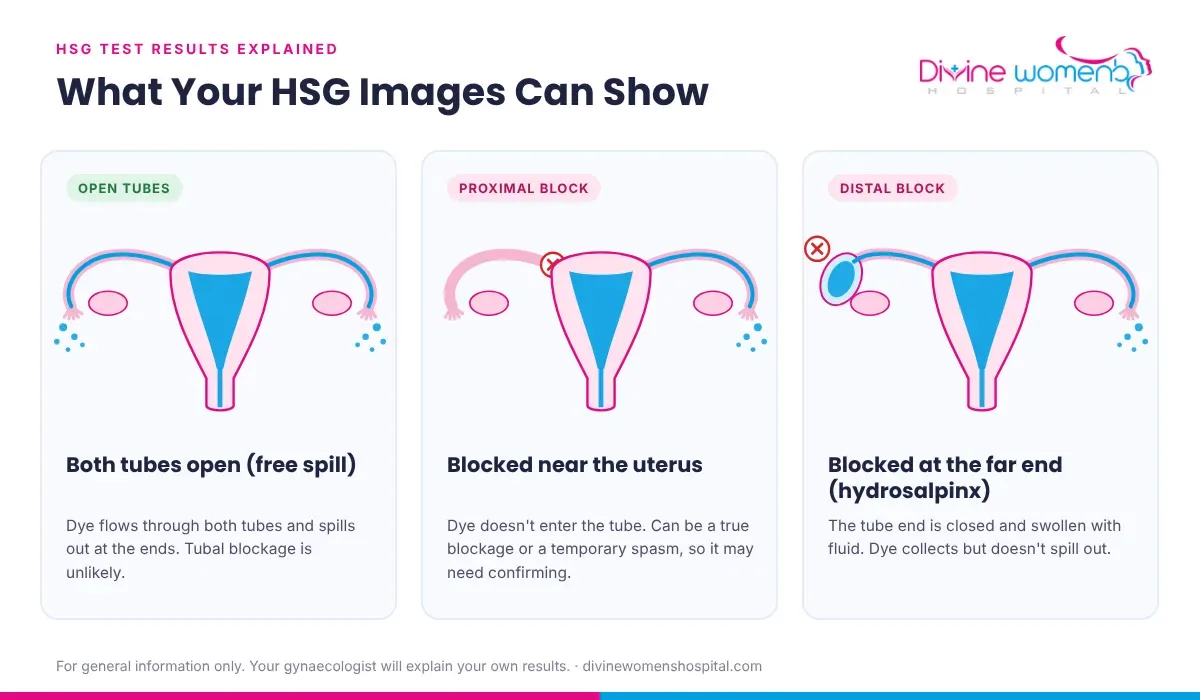
The doctor or radiologist will tell you what the images show, and your gynecologist will explain what it means for you.
| HSG result | What it means | Possible next steps |
|---|---|---|
| Both tubes open (bilateral free spill) | Dye flows freely through both tubes. Tubal blockage is unlikely. | Continue the rest of the fertility evaluation and treatment as advised. |
| One tube open, one blocked | Pregnancy is still possible through the open tube. | Trying naturally for a time, ovulation induction or IUI on the side of the open tube, or further tests, depending on age and other factors. |
| Blockage near the uterus (proximal) | Dye does not enter the tube. This may be a true blockage, or a temporary spasm of the tube. | Often a repeat test or confirmation with laparoscopy or hysteroscopy; hysteroscopic tubal cannulation may open it. |
| Blockage at the far end (distal), or hydrosalpinx | The tube end is closed and may be swollen with fluid. | Laparoscopic assessment. Before IVF, a hydrosalpinx is often removed or clipped, as fluid can lower IVF success. |
| Both tubes blocked | The egg and sperm cannot meet naturally. | Laparoscopy to assess repair options, or IVF, which bypasses the tubes. |
| Abnormal uterine cavity | Possible polyp, fibroid, adhesions (Asherman syndrome) or septum. | Hysteroscopy to confirm and treat. |
Can an HSG show a false “blockage”?
Yes. HSG is very useful, but it is not perfect. A large analysis estimated its sensitivity at about 65% and specificity at about 83% for tubal problems. A “blocked” result near the uterus can sometimes be caused by a temporary muscle spasm of the tube rather than a true blockage. If your HSG shows a proximal blockage, your doctor may suggest a repeat test or a laparoscopy, which is the most definitive test, before deciding on treatment.
What Happens Next if a Tube Is Blocked?
Treatment depends on where the blockage is, how many tubes are affected, your age, your egg reserve and your partner’s semen analysis. Options include:
| Option | When it may be considered |
|---|---|
| Repeat HSG or sonosalpingography | To confirm a blockage near the uterus that may have been a spasm. |
| Laparoscopy with chromopertubation (dye test) | To see the tubes directly and treat adhesions or endometriosis at the same time. |
| Hysteroscopic tubal cannulation | To open a blockage close to the uterus from inside. |
| Laparoscopic tubal surgery | For selected cases of blockage at the far end, or adhesions around the tube. |
| Removal or clipping of a hydrosalpinx | Before IVF, when a fluid-filled tube could reduce IVF success. |
| IUI | When at least one tube is open and other factors are suitable. |
| IVF | When both tubes are blocked or badly damaged, or when surgery is not likely to help. IVF does not need the tubes. |
The goal is not only to open a tube, but to choose the option that gives you the best realistic chance of pregnancy. Your gynecologist will discuss the options with you, including the risks, recovery and costs.
Learn more about tubal blockage treatment at Divine Women’s Hospital, IUI and IVF.
Can an HSG Improve Your Chances of Getting Pregnant?
Some studies suggest that flushing the tubes during HSG may slightly improve the chance of natural pregnancy in the following months, especially with oil-based contrast. In a large Dutch randomised trial (H2Oil, New England Journal of Medicine, 2017), ongoing pregnancy rates within 6 months were 39.7% with oil-based contrast compared with 29.1% with water-based contrast.
The HSG is still mainly a diagnostic test, though, and whether oil-based contrast is suitable depends on your situation. Ask your doctor which contrast will be used and why.
HSG vs Other Tubal Tests
| Test | How it works | Main advantage | Limitation |
|---|---|---|---|
| HSG | X-ray with contrast dye | Widely available; shows tubes and uterine cavity | Small radiation dose; may show a false proximal blockage |
| Sonosalpingography / HyCoSy / HyFoSy | Ultrasound with saline or foam | No radiation; also shows ovaries and uterus | Accuracy depends on operator experience |
| Laparoscopy with dye test | Keyhole surgery under anaesthesia; tubes seen directly | Most definitive; can treat problems at the same time | A surgical procedure; needs anaesthesia and recovery time |
Frequently Asked Questions
An HSG (hysterosalpingogram) is an X-ray test that uses a contrast dye to show whether the fallopian tubes are open and whether the inside of the uterus has a normal shape. It's commonly done as part of an infertility evaluation.
Most women feel period-like cramps during the dye injection, which usually ease within a few minutes to a few hours. A painkiller taken before the test, as advised by your doctor, can help. The pain may be stronger if a tube is blocked.
It's usually done after your period ends and before ovulation, typically around day 7–10 of the cycle. This makes sure you are not pregnant and gives a clearer view of the uterus.
The X-ray part usually takes less than 5 minutes. The whole appointment, including preparation, usually takes about 15–30 minutes.
Yes. If your tubes are open, you can try to conceive in the following cycles as your doctor advises. Some studies show a small increase in natural pregnancy rates in the months after an HSG, particularly with oil-based contrast.
Your doctor will look at where the blockage is and whether one or both tubes are affected. A blockage near the uterus is sometimes a temporary spasm and may need a repeat test or laparoscopy to confirm. Treatment options include hysteroscopic or laparoscopic procedures, IUI if one tube is open, or IVF.
Yes, HSG is considered a very safe test. Serious complications such as pelvic infection are uncommon. Tell your doctor if you could be pregnant, have an active infection or have had a reaction to contrast dye before.
Most women can return to normal activities, including work, the same day. You may have mild cramps and light spotting for a day or two.
References
- American Society for Reproductive Medicine. Hysterosalpingogram (HSG) – Patient Fact Sheet.
- Cleveland Clinic. Hysterosalpingogram (HSG).
- Princess Alexandra Hospital NHS Trust. Hysterosalpingogram (HSG) patient information leaflet.
- Dreyer K, et al. Oil-Based or Water-Based Contrast for Hysterosalpingography in Infertile Women. N Engl J Med. 2017;376:2043–2052.
- Swart P, et al. The accuracy of hysterosalpingography in the diagnosis of tubal pathology: a meta-analysis. Fertil Steril. 1995.
- Comparison of HyFoSy, HyCoSy and X-ray hysterosalpingography in the assessment of tubal patency: a systematic review and meta-analysis.
If you have been trying to conceive and your doctor has recommended tubal testing, the gynecology and fertility team at Divine Women’s Hospital can explain whether an HSG or another test is right for you, and talk you through your results and options. Read more about tubal blockage treatment.
If you have severe abdominal pain, fever or heavy bleeding after an HSG, contact the hospital immediately or go to the nearest emergency department.
What to expect at Divine Women's Hospital
Choosing where to be cared for is a personal decision, and it usually comes down to one question: will someone actually listen to me? At Divine Women's Hospital, that is where every consultation begins. Our senior consultants stay with you from the first visit through recovery, so you never have to repeat your story to a new face.
One consultant, start to finish
The doctor who examines you is the doctor who plans your treatment and performs your procedure. Continuity is not a luxury here, it is the baseline.
Explained in plain language
Reports are walked through line by line, in Gujarati, Hindi or English, until the plan makes sense to you and the family member sitting beside you.
Modern theatre and imaging under one roof
Laparoscopy suites, fetal-medicine grade ultrasound, NICU support and 24×7 emergency cover mean fewer referrals and less waiting between steps.
Honest, itemised costs
You receive a written estimate before admission. If the plan changes, we tell you why before anything is done.
Related Reads
21 August 2026
NT-NB Scan Results Explained: What Do High-Risk and Low-Risk Reports Mean?
Introduction You just got your NT-NB scan report back, and there’s a number on it that’s making your heart race. Maybe it says “1:180.” Maybe it says “high risk.” Maybe your doctor used a word like “flagged” and moved on before you could ask what that actually means for your baby. Take a breath.
Read more
14 August 2026
What Is an NT Scan in Pregnancy? Purpose, Timing & Procedure Explained
If someone just mentioned “NT scan” at your prenatal visit and you nodded along without fully understanding it, you’re in good company. It’s one of those terms doctors use daily that rarely gets fully explained to patients.
Read more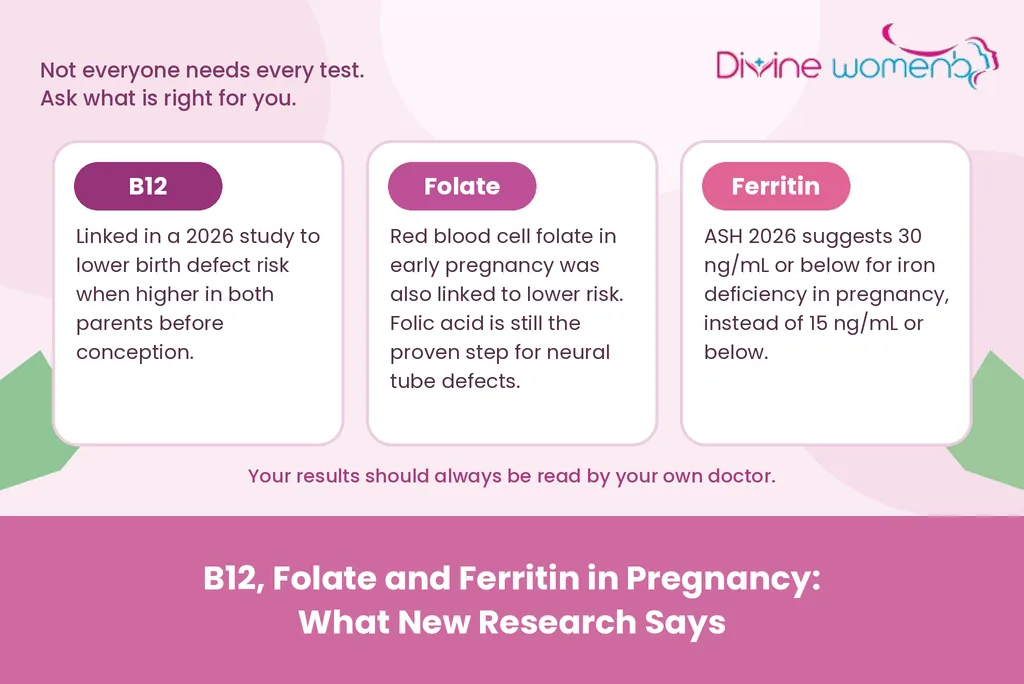
19 November 2026
B12, Folate and Ferritin in Pregnancy: What New Research Means for You
You took your folic acid every day. Your haemoglobin report said “normal”. So why are doctors suddenly talking about vitamin B12 and ferritin? Two pieces of 2026 research are changing how we think about nutrition and screening around pregnancy.
Read moreWe are here for you
Book a consultation with our women's health team in Ahmedabad
Obstetricians, gynecologists, fertility specialists and a neonatologist, with hospital staff available 24×7 for you and your baby.