
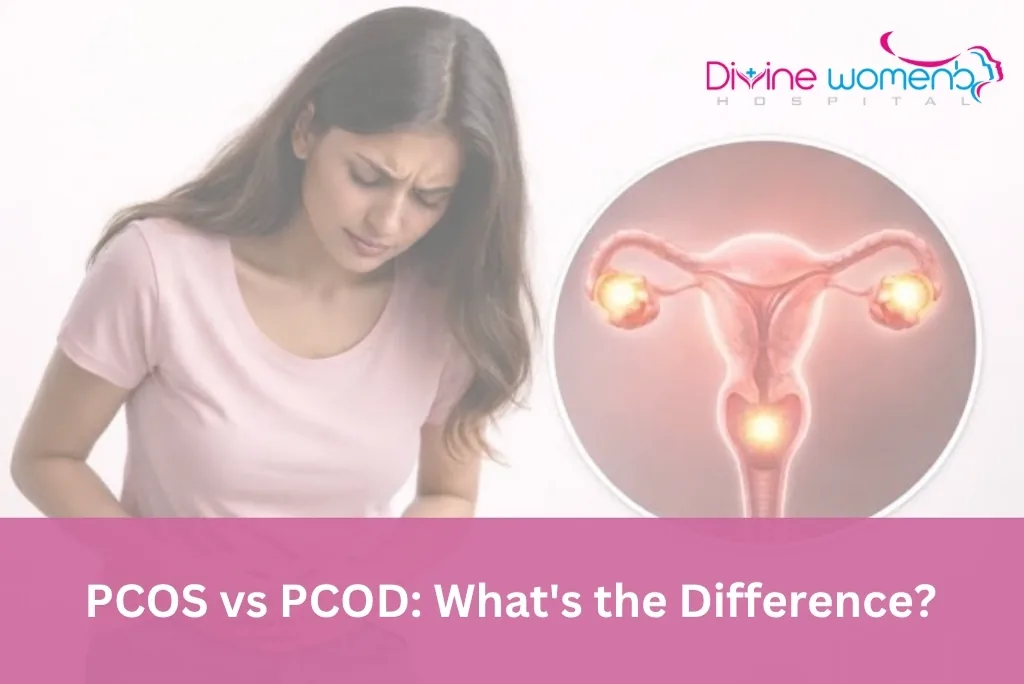
PCOS vs PCOD: What's the Difference?
This article is written by our clinical team for the women and families we meet every day. It is meant to inform you, not to replace a consultation, and every recommendation here is one we would give you in the room.
If you've heard both “PCOS” and “PCOD” used for the same set of symptoms and wondered which one you actually have, here's the short answer: they're the same condition. This guide explains what the medical criteria for PCOS actually require, why “PCOD” isn't a recognised diagnosis, and what the real symptoms, risks, and treatment options look like.
This article is for general educational purposes only and does not replace personalised medical advice, diagnosis, or treatment. Talk to your provider about your specific symptoms and test results.
In short: PCOS (Polycystic Ovary Syndrome) is the official medical diagnosis, defined by having at least 2 of 3 features - excess androgen signs, irregular ovulation, or polycystic ovaries on ultrasound. “PCOD” is a colloquial term, especially common in South Asia, used interchangeably with PCOS. It isn't a separate, formally recognised diagnosis in international guidelines.
Key Takeaways
- PCOS affects roughly 5-15% of reproductive-age women, depending on which diagnostic criteria are used.
- “PCOD” and “PCOS” describe the same underlying condition - major guidelines don't distinguish them as separate diseases.
- Insulin resistance is present in up to 70% of PCOS cases and drives much of the hormonal imbalance.
- Diagnosis requires ruling out thyroid disease, high prolactin, and other hormone conditions that mimic PCOS.
- Treatment is tailored to your goals - cycle regulation and anti-androgens if you're not trying to conceive, or ovulation induction if you are.
Is PCOD a Different Condition from PCOS?
The confusion is understandable: two acronyms, one syndrome. PCOS is the term used in international guidelines - Rotterdam, NIH, and the Androgen Excess and PCOS Society all define it with specific diagnostic criteria. PCOD, by contrast, has no formal diagnostic criteria of its own; it's simply a regional label for the same combination of irregular ovulation and ovarian follicle changes.
Some non-medical sources describe PCOD as a “milder, lifestyle” version and PCOS as more severe - but this distinction isn't evidence-based or recognised by major medical bodies. Even reference sources like MedlinePlus list “polycystic ovary disease (PCOD)” simply as an alternate name for PCOS.
| PCOS | PCOD | |
|---|---|---|
| Official diagnosis? | Yes - defined by Rotterdam/NIH/AE-PCOS criteria | No formal criteria; informal regional term |
| Used in major guidelines? | Yes, worldwide | Rarely, mostly South Asian lay literature |
| Underlying condition | Same | Same |
| Treatment approach | Same | Same |
How PCOS Is Actually Diagnosed
Diagnosis requires 2 of these 3 features, after ruling out other causes:
- Hyperandrogenism - clinical signs (excess facial or body hair, acne, scalp hair thinning) or a blood test showing elevated testosterone.
- Ovulatory dysfunction - irregular or absent periods (cycles shorter than 21 days, longer than 35 days, or fewer than 8 cycles a year).
- Polycystic ovaries on ultrasound - 12 or more small follicles per ovary, or increased ovarian volume.
Before confirming PCOS, your provider will typically check thyroid function (TSH), prolactin, and a morning 17-hydroxyprogesterone level to rule out thyroid disease, high prolactin, and a mild adrenal condition that can mimic PCOS symptoms. A pregnancy test is standard for anyone with missed periods.
Symptoms You Might Notice
- Irregular or absent periods - the most common sign, seen in more than 80% of cases.
- Excess hair growth or acne - hirsutism (coarse hair on the face, chest, or back) affects roughly 70% of patients; persistent adult acne is also common.
- Weight and metabolic signs - 40-80% of people with PCOS are overweight or obese, though lean PCOS (normal BMI) accounts for at least 20-30% of cases. Darkened skin at the neck or underarms (acanthosis nigricans) can signal insulin resistance.
- Ovarian appearance on ultrasound - a “string of pearls” pattern of small follicles, though this alone isn't enough for diagnosis since up to 25% of people without PCOS have similar-looking ovaries.
- Difficulty conceiving - due to irregular or absent ovulation, PCOS is the most common cause of ovulation-related infertility.
What's Happening in the Body
At the core of PCOS is a cycle involving two things: excess androgens from the ovaries, and insulin resistance, present in up to 70% of cases. High insulin levels push the ovaries to produce more androgens and lower a protein that normally keeps testosterone bound and inactive - so more testosterone ends up free and active in the bloodstream.
These excess androgens disrupt normal follicle development, which is why ovulation becomes irregular or stops altogether. It becomes a self-reinforcing loop: insulin resistance drives androgen excess, and androgen excess makes the metabolic picture worse.
What the Evidence Shows
Population data show PCOS affecting roughly 5-15% of reproductive-age women, varying by which diagnostic criteria are applied - narrower NIH criteria yield lower estimates (around 6-10%), while the broader Rotterdam criteria push figures toward 10-15% or higher.
Among women with PCOS, studies find 30-35% have impaired glucose tolerance and 3-10% have type 2 diabetes, notably higher than age-matched peers without the condition. With appropriate treatment, roughly 70-80% of people with PCOS-related infertility go on to conceive.
Long-Term Health Risks
PCOS carries risks beyond irregular periods. Insulin resistance raises long-term risk of type 2 diabetes and dyslipidaemia, which is why regular glucose and lipid screening is recommended. Unopposed estrogen exposure from chronic anovulation raises the risk of endometrial hyperplasia and, over time, endometrial cancer - a key reason long stretches without a period shouldn't go unaddressed.
During pregnancy, PCOS is linked to a higher chance of gestational diabetes and pregnancy-related hypertension, which is part of why some PCOS pregnancies benefit from closer specialist monitoring. Depression, anxiety, and sleep apnoea also occur more often in PCOS and are worth mentioning to your provider even if they feel unrelated to your periods.
Treatment Options
If you're not trying to conceive:
| Option | What it does |
|---|---|
| Combined hormonal contraceptives | Regulates cycles, protects the uterine lining, and improves acne and hirsutism over time |
| Spironolactone (100-200 mg/day) | Anti-androgen, typically paired with contraception, for excess hair growth and acne |
| Metformin | Improves insulin sensitivity; modestly helps cycle regularity, especially if overweight |
If you're trying to conceive:
| Option | What it does |
|---|---|
| Letrozole | First-line ovulation induction, generally preferred over clomiphene for higher pregnancy rates |
| Clomiphene citrate (50-150 mg/day for 5 days) | Alternative ovulation induction option |
| Gonadotropin injections / ovarian drilling | Considered if oral medications don't work |
| IVF | Option if simpler fertility treatments are unsuccessful |
For everyone: a modest 5-10% weight loss can meaningfully improve insulin sensitivity and, in some cases, restore ovulation. A low-glycaemic or Mediterranean-style eating pattern and regular activity are the standard starting point - see our guides to lifestyle management for PCOS and fertility treatments for PCOS.
Frequently Asked Questions
Major international guidelines - Rotterdam, NIH, and the Endocrine Society - recognise only PCOS as a diagnosis. “PCOD” is a regional, colloquial term for the same condition, not a distinct or milder disease.
Conclusion
Whether your provider says “PCOS” or “PCOD”, you're dealing with the same underlying hormonal condition - one defined by specific diagnostic criteria, not by which acronym gets used locally.
Understanding the real criteria, symptoms, and treatment options rather than the terminology is what actually helps you manage it, whether your priority is regulating your cycle, addressing acne and hair growth, or planning a pregnancy.
Next step: if you suspect PCOS or PCOD, ask your provider for the standard workup - TSH, prolactin, testosterone, and a pelvic ultrasound - so you get a clear diagnosis and a treatment plan matched to your actual goals.
When to See a Doctor
Seek prompt medical attention for very heavy or prolonged bleeding, sudden severe pelvic pain, or rapid-onset hair growth and voice changes - the last two can occasionally signal a rarer hormone-producing tumour rather than typical PCOS and warrant a closer look.
References
- MedlinePlus - Polycystic Ovary Syndrome (PCOS).
- Cleveland Clinic - Polycystic Ovary Syndrome (PCOS).
- Teede et al. - International Evidence-Based Guideline for the Assessment and Management of PCOS (2018, 2023 update).
- Legro et al. - Endocrine Society Clinical Practice Guideline on PCOS diagnosis and treatment.
This overview reflects current international consensus (Rotterdam/NIH/AE-PCOS criteria and Endocrine Society guidance) on PCOS diagnosis and management. Individual treatment plans should be built with your provider based on your specific labs and goals.
Whichever term you were given, PCOD/PCOS treatment at Divine Women's Hospital, Ahmedabad starts with the full workup above - TSH, prolactin, testosterone and a pelvic ultrasound - then a plan matched to whether you're managing symptoms or trying to conceive. Dr. Devang Patel holds an M.D. in Obstetrics & Gynecology.
What to expect at Divine Women's Hospital
Choosing where to be cared for is a personal decision, and it usually comes down to one question: will someone actually listen to me? At Divine Women's Hospital, that is where every consultation begins. Our senior consultants stay with you from the first visit through recovery, so you never have to repeat your story to a new face.
One consultant, start to finish
The doctor who examines you is the doctor who plans your treatment and performs your procedure. Continuity is not a luxury here, it is the baseline.
Explained in plain language
Reports are walked through line by line, in Gujarati, Hindi or English, until the plan makes sense to you and the family member sitting beside you.
Modern theatre and imaging under one roof
Laparoscopy suites, fetal-medicine grade ultrasound, NICU support and 24x7 emergency cover mean fewer referrals and less waiting between steps.
Honest, itemised costs
You receive a written estimate before admission. If the plan changes, we tell you why before anything is done.
Related Reads

17 October 2026
C-Section Recovery: Wound Care & Healing Timeline
A cesarean heals through several tissue layers, not just the visible scar, and on a longer timeline than a vaginal birth. The four recovery phases, when scar massage is actually safe, what binders do, and the infection signs to act on.
Read more
17 October 2026
Vaginal Birth Recovery: Soreness, Discharge & Afterpains Explained
Uterine afterpains, lochia stages and perineal healing all follow a predictable timeline after a vaginal birth. What is normal week by week, and the handful of warning signs that mean you should call your provider rather than wait.
Read more
17 October 2026
Genetic Screening & Pre-Pregnancy Tests: What to Know
Carrier screening tells you something prenatal testing can't: your risk of passing on an inherited condition while every reproductive option is still open. What the panels check, how the guidelines differ, and why timing it before conception changes what you can do with the result.
Read moreWe are here for you
Book a consultation with our women's health team in Ahmedabad
Obstetricians, gynecologists, fertility specialists and a neonatologist, with hospital staff available 24×7 for you and your baby.