
Painless Delivery in Ahmedabad
Labour pain is not something you have to prove you can endure. Effective pain relief is available, and choosing it does not make the birth any less yours.
Painless delivery usually means an epidural: a fine tube placed in the lower back through which anaesthetic is given, numbing the pain of contractions while you stay awake, alert and able to push.
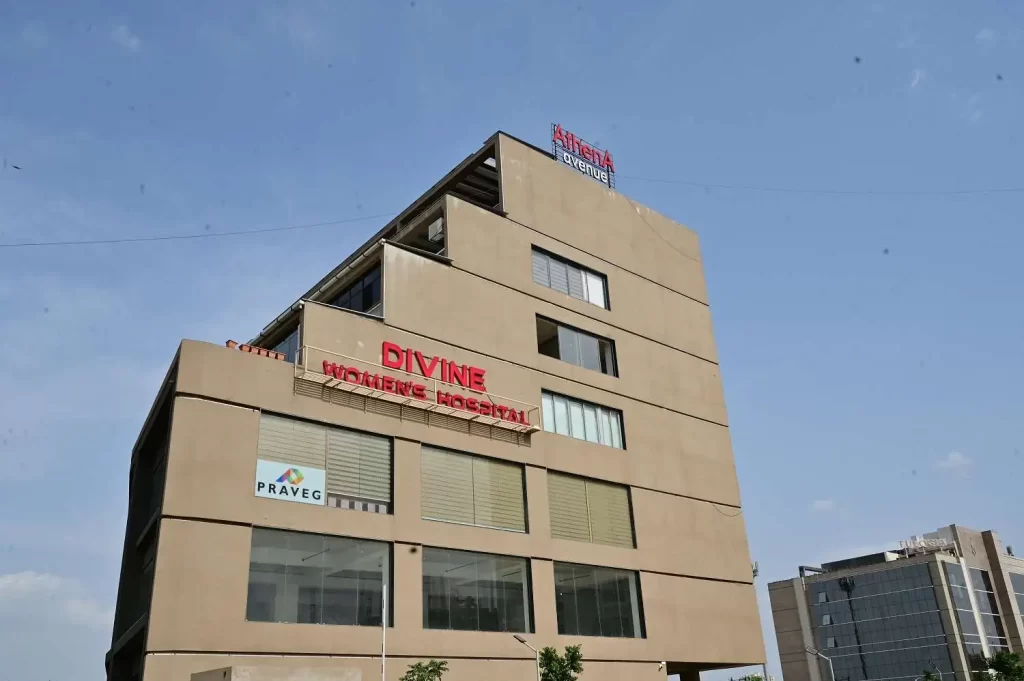
At Divine Women's Hospital, Ahmedabad, an anaesthetist is available around the clock, so pain relief can be started when you need it — not when someone can be called in.
What an Epidural Does
An epidural blocks pain signals from the lower half of the body while leaving you fully conscious.
- You stay awake and aware throughout, and can still feel pressure and push
- Pain relief can be topped up as labour progresses
- It can be used if you later need a caesarean, avoiding a general anaesthetic
- Your baby is not sedated by it
- You can usually still move your legs, though standing and walking are limited
What It Does Not Do
An epidural does not make labour longer in any way that matters for most women, and current evidence does not show that it increases the chance of a caesarean section.
It does not remove all sensation. You will still feel pressure, and you will know when to push — which is what makes a controlled delivery possible.
It is also not a decision made once and locked in. If you plan to manage without one and change your mind in labour, that is an entirely reasonable thing to do.
Pain Relief Options in Labour
| Option | What it involves |
|---|---|
| Epidural analgesia | A fine tube in the lower back giving continuous, topped-up pain relief. The most effective option. |
| Injectable analgesia | Pain-relieving medication given by injection — takes the edge off rather than removing pain. |
| Warm water immersion | Labouring in warm water eases pain for many women, available through our underwater birth facility. |
| Position and movement | Changing position, upright labouring and breathing techniques, supported throughout. |
Who Can Have an Epidural
Most women in normal labour can. Whether it is suitable for you depends on your clotting profile, any spinal problems or previous back surgery, infection at the injection site, and how far labour has already progressed.
Your obstetrician and anaesthetist will assess you together and tell you plainly if it is not advisable — and what else is available if so.
What to Expect
You will be asked to curl forward while sitting or lying on your side. The skin is numbed first, then the epidural is placed. It takes a few minutes, and pain relief usually begins within about 15 to 20 minutes.
A drip and monitoring of your blood pressure and your baby's heart rate continue afterwards. A catheter is often needed because sensation to the bladder is reduced. Some women get a temporary drop in blood pressure or shivering, both of which are managed straightforwardly.
Deciding About Pain Relief Before Labour
The best time to think about pain relief is during your antenatal visits, not in the middle of a contraction. We will explain the options, tell you which are suitable for you, and put it in your birth plan.
It is your decision, and it can change. Nobody here will make you justify wanting an epidural, and nobody will push one on you if you would rather manage without.
What Your Anaesthetist Will Check
Before an epidural is placed:
- Your clotting profile and platelet count
- Any back problems or previous spinal surgery
- Infection at or near the injection site
- Allergies and current medication
- How far labour has progressed
- Your blood pressure and general condition
Dr. Devang Patel | Gynaecologist & Obstetrician

At Divine Women's Hospital, Ahmedabad, pain relief is planned during your antenatal visits and available around the clock when labour starts.
Dr. Devang Patel is a Gold Medalist in M.D. Obstetrics & Gynecology with an FNB in High Risk Pregnancy and Perinatology, working alongside an anaesthetist present at the hospital 24×7.
A dedicated operation theatre and NICU support are on site should anything need to change during labour.
Wanting pain relief in labour needs no justification. It is a clinical option, not a test of character.
If you would like to discuss pain relief for your delivery, raise it at your next antenatal visit — or book a consultation.
Frequently Asked Questions
Current evidence does not show that it does. It may slightly lengthen the pushing stage, and it increases the chance of needing help with forceps or vacuum in some women, but it is not associated with more caesarean deliveries.
Related treatments
Why families across Gujarat trust Divine Women's Hospital
Choosing where to be cared for is a personal decision, and it usually comes down to one question: will someone actually listen to me? At Divine Women's Hospital, that is where every consultation begins. Our senior consultants stay with you from the first visit through recovery, so you never have to repeat your story to a new face.
One consultant, start to finish
The doctor who examines you is the doctor who plans your treatment and performs your procedure. Continuity is not a luxury here, it is the baseline.
Explained in plain language
Reports are walked through line by line, in Gujarati, Hindi or English, until the plan makes sense to you and the family member sitting beside you.
Modern theatre and imaging under one roof
Laparoscopy suites, fetal-medicine grade ultrasound, NICU support and 24x7 emergency cover mean fewer referrals and less waiting between steps.
Honest, itemised costs
You receive a written estimate before admission. If the plan changes, we tell you why before anything is done.
We are here for you
Book a consultation with Ahmedabad's trusted women's health team
Internationally certified obstetricians, gynecologists and fertility specialists, available 24×7 for you and your baby.